



We love to travel, and whenever we can, we go on vacation or on weekends, extended thanks to the many French public holidays.
I (Floriane) lived in the Netherlands, nearAmsterdam, for a year through the Erasmus program . Matthieu and I had been talking for a long time about going to work abroad.
One day, a colleague quit his job to go on a round-the-world trip. At first, I thought this project was completely crazy. How is it possible to leave for a year without working?
Then, after several exchanges with Matthieu and research on the Internet, reading numerous blogs and travel reports, we said to ourselves “why not us? A year and a half after our first discussions on the subject, we took off, tears in our eyes of happiness, for the São Paulo Carnival.
To date, it’s the project we’re most proud of. We got to know each other better and never regretted our choice.
Through this blog, we hope to inspire other travelers in need of adventure! In this article, we explain in detail our year of preparation, we answer all the questions we asked ourselves, when to leave, what insurance to take… we detail our budget and our itinerary.

When to go and for how long?
When should you leave?
This is obviously a very personal decision. As for us, Matthieu was an entrepreneur before we left. So he was able to wind down his business before leaving.
For my part, as an employee, I decided to resign so that we could leave at a time that worked for us. I even turned down a long-awaited promotion for this project. Today, I have absolutely no regrets about that decision.
Generally, the long-term travelers we met were between the ages of 25 and 30 and had some work experience under their belts that had allowed them to save up a little money.

What is the average length of a round-the-world trip?
According to a survey by the Tourdumondiste website, three-quarters of round-the-world trips last between 5 and 13 months. However, this statistic mainly applies to travelers who are in a couple or traveling as a pair.
As for us, we were gone for 12 months because we had bought our plane tickets through a travel agency and had to return no later than one year after our departure. Of course, we chose the maximum allowed duration!
Since then, our family trips have made us realize that there’s a much wider variety of travel options when you’re traveling with children. Of course, there’s the classic school-year-long trip, but there are also families who prefer to travel for two or three months every few years. In fact, we have friends who’ve chosen this approach.
Since we ’ve been living on the island of Oléron, we’ve also come across another type of traveler: seasonal travelers. They maintain their lives and homes in France for part of the year, then set off to travel for several months, often during the winter. Ultimately, there isn’t really an “ideal” length of time—it depends mainly on your family, work, and school situations, as well as your travel style.

What’s the budget?
The average budget for a one-year round-the-world trip
The average budget for a one-year trip around the world is €15,000 (per person without children); today, you should budget 25% more, or about €20,000. This is what we’ve found from talking to other travelers we’ve met along the way and from reading numerous blogs.
Obviously, this budget can vary enormously from one project to another. For example, if you don’t want to fly, you’ ll save between €3,000 and €4,000 on your overall budget. If you’re traveling for a year in Asia, your budget will also be considerably lower.
Conversely, if you want to visit every continent, this will increase your air travel budget. If you stay in the most expensive countries, such as the USA, Australia, New Zealand, Canada or the islands, your budget will increase considerably.
We explain below how to obtain the average budget by country.


How to save money (without depriving yourself)?
This is the question on everyone’s mind: without a minimum amount of money set aside, this project becomes more complicated to carry out. Don’t panic, as explained below, we’ve met travelers on tight budgets, so we’ll also explain where to go depending on your budget.
Below, we’ve outlined our tips for quickly saving money —and, most importantly, without having to give anything up.
- Take stock of your expenses: we manually listed all our expenses for the last 3 months on Excel and then categorized them: rent, taxes, subscriptions (internet, telephone, Netflix…), supermarket food, clothing, leisure food (restaurants/bars), and travel/weekends.
I quickly realized that I was spending almost 15% of my budget on clothing. I had only been working for a few years, and had become a real shopping addict… I never thought I’d spend that kind of money on a few shopping sprees.
About a year and a half before our departure, I completely changed my habits to save this amount for our trip.
If you don’t want the hassle of processing your banking data by hand (on Excel), you can download a budget management application such as Nestor, Linxo…

2. Cut back on leisure spending: We used to go on a long weekend trip about once a month, either in France or abroad, and we also spent three weeks abroad each year. Since we knew a year-long trip was coming up, we naturally decided to scale back our travel.
For example, we spent time with our families, during our vacations, the year before we left. We have also given priority to more economical carpooling.
We saved the money for a trip and several weekends!

3. Sell your stuff: we lived in a 40 m2 Parisian apartment full of stuff we didn’t use (electronics, clothes, books…).
As you might guess, the bon coin has become our best friend! About 6 months before our departure, we sorted our belongings and placed our ads on the site. As the trip approached, we had at least 1 appointment a day to sell something!

4. Focus on purchases for the trip: don ‘t renew your wardrobe before you leave. If you want a new pair of shoes some time before your planned departure date, try to reason with yourself! You’re leaving in a few months, so if you’re not planning to take it with you, wait until you get back to change it.
Your belongings will be stored during your trip, so they may deteriorate. We found some clothes with moth holes, even though we had taken great care to store them in a dry, healthy place.
5. Rent out your apartment on a platform like Airbnb: for this, of course, you need to be a homeowner. Unfortunately, we were unable to do so. We’ve met travelers who were able to earn a few hundred euros for their trip.
Le bon coin , which we don’t even introduce anymore, is ideal. We sold many goods (clothes, electronics, books…)
Momox for books: by scanning the barcode on your books, the site will tell you their redemption price. You can drop off your parcel at a relay point. The site bears the shipping costs. The advantage is that you can sell several books at the same time.
Vinted , which specializes in clothing, didn’t exist at the time. Today, I use it to sell business. If you’d like to take a look, my username is morissetfloriane.
– Use a cashback site:
Igraal: We love this site—it lets you earn money from the purchases you make. Whenever you make a purchase at one of the partner sites (about 1,400 sites), you’ll earn a commission (money). For example, we used it when buying our washing machine at Darty. By following this link, you’ll earn a €3 welcome bonus—and we’ll earn €3 too!
– Accommodations:
Airbnb: If you’re a homeowner, you can list your place on Airbnb—the site will show you how much you could earn!


Main expense items
For our part, we spent €15,000 per person. You’ll find our main expenses below.
We didn’t have to set aside any money for vaccines because our health insurance covered them. We were happy to discover this pleasant surprise, since the bill came to €500 per person.
We also don’t have a budget for gear, since we managed to get almost all of our gear as gifts for our birthday and at Christmas before the trip. We also already owned a good portion of it, since we’d invested in it during previous trips. You can easily estimate about 1,000€ per person.
|
Our detailed budget for our one-year round-the-world trip
|


Our method for planning an itinerary
Building a travel itinerary is no easy task. In any case, you won’t be able to do or see everything. And do you know what? Well, it doesn’t matter, you’re going to see a lot during your trip, whether you visit 1 or 15 countries.
How to create your itinerary
1/ You need to decide on a list of countries or places you’d like to visit. We made a list on our own, drawing inspiration from the internet and travel books such as “Terre secrète – Merveilles insolites de la planète” and “1000 idées de voyages du Lonely Planet”.
It’s important to respect each person’s wishes and desires, so that the two of you can build this trip together from the outset. This is our favorite part of the planning process. You can let your imagination run free for the time being without constraint.
Then we printed out a world map and colored in all the countries we’d noted, in green for Matthieu and pink for Floriane. We couldn’t wait to see the results and each other’s choices – phew, we had countries in common!
2/ You have to limit yourself…! This really isn’t the easiest part. We’ve chosen to travel to 1 country per month. We followed the advice given on the travel blogs.
That’s good, but often too little. For example, Argentina is almost the size of Europe, so imagine going around Europe in 1 month…
It’s a very personal choice. Don’t panic, you can also adapt your itinerary to suit your local needs. During our trip to Asia, we withdrew from Vietnam to spend more time in Cambodia and Sri Lanka.


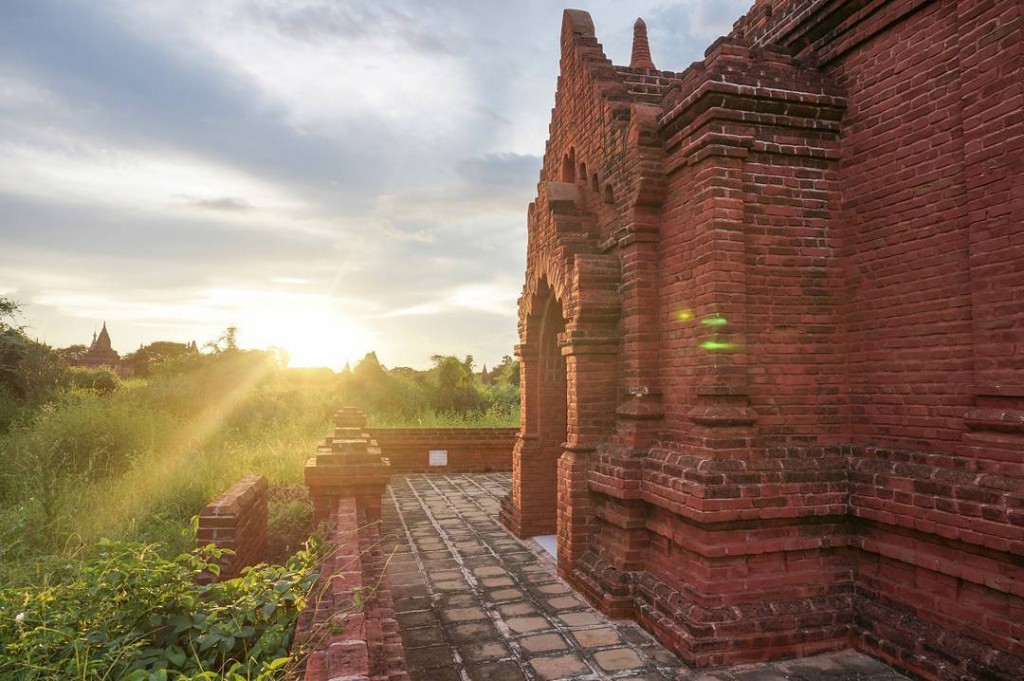
Where can I find information on the different countries?
This is where the long and interesting part comes in… reading the thousands of travel blogs! It’s a gold mine for planning and imagining what you can do in the country, and how much time you can spend there.
Try to choose between 2 and 3 to avoid spreading yourself too thin. You’ll also get a lot of local information from your hosts and other travelers.
– A2pasdumonde, by Anais and Julien, our friends we met onEaster Island (how cool is that)! They had just come from Asia, and we had just come from South America. So we drew inspiration from their journey during our 7 months in Asia! You’ll find useful and detailed information about the different countries they traveled through.
– Novo-monde is a go-to resource for the world of around-the-world blog tours and backpacking. Fabienne and Benoit write very comprehensive articles.


Plan your route
Now you need to adjust your plans based on the weather and your budget. For this part, the trip planner from the blog “À contre-sens” was a huge help. It’s not the most enjoyable part of planning. Much to our regret, we had to drop New Zealand from our itinerary because we would have been there in the middle of winter.
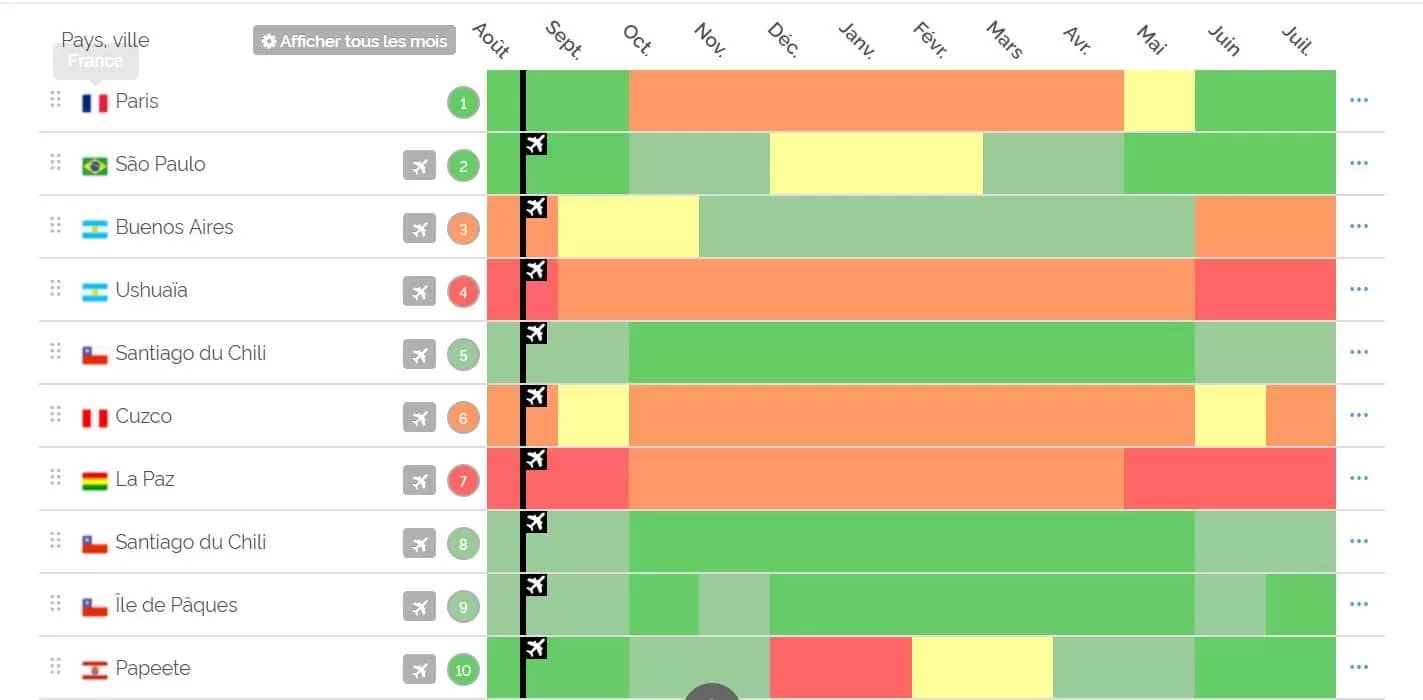
This is an important step that will help you avoid climate and budget setbacks. By taking a month off in New Zealand, we could live another month in Asia.
We entered our draft itinerary, then the software showed us the estimated budget and the most favorable climate by country/region.
Now you’ve got your list of countries and the order in which it’s best to do them. Now all you have to do is buy your plane tickets!
A word of advice: in the beginning, you’ll have plenty of energy and drive, so 1 country a month is fine. Beyond 6 months, however, you’ll probably start to get tired, and it’s better to plan fewer countries and choose to stay longer in each selected country.

Choosing your plane tickets
- Booking through a specialized agency: that’s the option we chose. This solution still allows you to maintain some flexibility in your itinerary. While ticket dates can generally be changed for free (as indicated on your itinerary), the same cannot be said for destinations.
For example, we had no difficulty in rescheduling our arrival date in Sri Lanka. We recommend that you contact several agencies. For our part, we asked Travel Nation and Zip World, and got a better feeling with the former for a similar price.
Going through an agency will also enable you to exchange ideas and optimize your itinerary with the help of a specialized advisor. For example, our contact at Travel Nation recommended that we spend a few days in Tahiti for the modest sum of €200. We wouldn’t have thought of it at all on our own.
- Buy your plane tickets yourself: this method gives you great flexibility, since you can buy your plane tickets as you go along. On the other hand, buying tickets at the last minute can be expensive.
- Join an alliance: there are three: Oneworld, Star Allianceand SkyTeam. We had compared the prices of the various alliances with our itinerary, and the price was higher than if we had used a specialist agency.


Choosing your travel health insurance
Am I covered with my credit card?
The question we couldn’t find the answer to. The easiest thing for us to do was to ask our bank directly. With our VISA and MASTER CARD bank cards, we were covered for 90 days if and only if we had a return ticket (with a date no more than 3 months after your departure date) in our possession. This was clearly not the case for us.
Our research also revealed that traditional bank cards offer very low levels of cover, with lower ceilings than traditional travel health insurance.
How to choose your insurance ?
For us, having the right insurance for our round-the-world trip was an obvious choice. We wanted to be covered in the event of a problem or the slightest doubt, and to be able to go to the doctor without hesitation (which is exactly what we did).
We compared different insurance offers and found useful information on many blogs. Generally speaking, all the insurances you will find on the market offer the same kind of formula. Rates vary according to several criteria:
- Amount of coverage provided
- Your age and the number of people covered
- The destination (Or zone: Europe / USA – Canada / Rest of the world)
We decided to choose the Cap Aventure formula from Chapka Assurance. In our opinion, this is the most interesting offer on the market. It offers a good ratio/guarantees/price.
Update—Before our long family trips (in a motorhome this time)— 10 months in Southern Europe and 5 months in Scandinavia—we compared different travel insurance policies once again.
Chapka always offered the best value for money. And now the teleconsultation service is included in the Cap Aventure package, so when we travel with children, it’s a luxury to be able to call at the slightest doubt.


Travel insurance: our feedback
Before our departure, we had come across many articles comparing travel insurance, but few feedbacks.
We wrote an article sharing our opinion and experience with Chapka, detailing when we had to file a claim and whether or not we were covered. We were completely satisfied with the service provided by Chapka, and in fact, we’ve continued to use this insurance for our other long trips.


Our one-year itinerary
After several months of reflection and many exchanges with our agency, we finally validated our final itinerary.
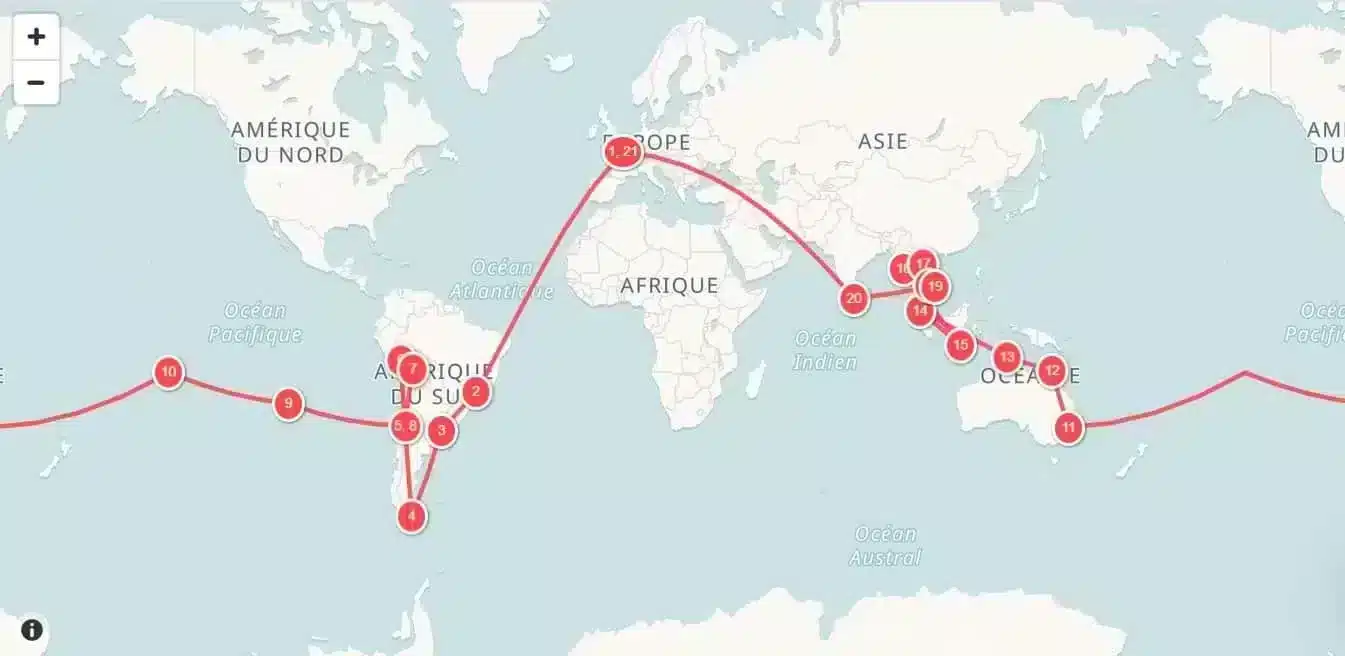
We started with South America(Argentina, Chile, Peru and Bolivia), with a stopover in São Paolo for Carnival.
Then we flew toAustralia via Easter Island and Tahiti.
We then spent 7 months traveling around Asia, passing through Malaysia, Indonesia, Myanmar (Burma), Laos, Cambodia and Vietnam. Finally, before heading home, we made one last stop in Sri Lanka.
In the end, we planned to spend around a month in each country, with a small bonus for Indonesia and Sri Lanka.
Compared with our dream itinerary, we had to withdraw a few countries for a number of reasons.
- To limit our travels and therefore the cost of our plane ticket, we had to concentrate on Southeast Asia, whereas we had dreamed of going to India, China and the Philippines.
- To keep up with the seasons, we didn’t stop in New Zealand, as we were there in July, in the middle of winter. This is an expensive country, so we preferred to come back later when the weather was milder.
We also adapted our itinerary to suit the visits of our friends and family. The aim was also to share this unforgettable journey with them!

The itinerary in detail
- February (5 days): Sao Paulo (Brazil)
- February (1 month): Argentina
- March (1 month): Chile
- April (1 month): Peru
- May (1 month): Bolivia
- June (5 days): Easter Island
- June (10 days): Moorea (Tahiti)
- June – July (3 weeks): Australia
- July (3 weeks) : Malaysia
- August – September (1? months): Indonesia
- September – October (1 month) : Myanmar
- November (1month) : Laos
- December (1month) : Cambodia
- January (3 days) : Vietnam
- February / March (1? months) : Sri Lanka
As you can see from our blog, we didn’t take the time to write here during our world tour. Instead, we loved putting together a few videos, which you can view here. We loved filming and editing our adventures, and we’re really looking forward to seeing these great moments again. We didn’t continue, as it takes even longer than writing articles…
Matthieu was also very present on Instagram, and had succeeded in federating a real community. It’s also something we didn’t develop due to lack of time, and yes, that’s always the worry! You can still see all our photos here.

Inspiring travel books and guides
In addition to the many blogs that we read regularly and the You Tube channels that we follow, we regularly read many travel reports.
– We leafed through numerous guidebooks to plan our itinerary, and we love the Lonely Planet and Routard guides. We like to bring them with us on every trip.
– We also consulted several travel books, 1000 travel ideas from Lonely Planet, Destination Petaouchnok… These books are inspiring and have given us lots of ideas. The images of the various sites are magnificent. We had written down so many ideas that we would have had enough for a 3-year round-the-world trip.
Update 2023– We’re off on another long-haul trip, touring Europe in a motorhome, with our daughter, who was 1 1/2 years old at the time of departure.
We still read a lot of travel books and stories, we buy a lot of them and of course our friends and family give them to us at every birthday or Christmas. If you have any travelling friends, it’s really the best gift to give:
➡️ ” Americana “, Luke Healy, a cross-country trek across America, we devoured this comic book, Luke Healy’s account of five months’ wilderness trekking on the Pacific Crest Trail. We loved it, because he left without being really prepared and without knowing what to expect, it was a great adventure – we love this philosophy of life!
➡️Et si on plaquait tout?: le pari fou d’une famille sur les routes du monde, Audrey de la Family Coste recounts their crazy adventure in an American caravan from Canada to Mexico. A reading that strongly inspired our year of travel in motorhome.
➡️”Chroniques birmanes” by Guy Delisle followed his partner for several months in Burma while she was working there with Médecins sans Frontières. He recounts his daily life through humorous anecdotes. An instructive and funny comic we’ve devoured yet again.
➡️”Africa trek – tome 1 From Cape Town to Kilimanjaro ” is the story of Sonia and Alexandre Poussin’s travels on foot, and now that they’re still travelling with their family, we’ve read almost all their stories – they’re real fans!
➡️ “L’odyssée électrique : 20.000 KM, 120 jours, un Tuktuk électrique” (Electric odyssey: 20,000 km, 120 days, an electric tuk tuk) is an account of a trip by electric tuk tuk, a highly original form of travel. A refreshing and once again inspiring story!


How This Experience Has Changed Our Lives
Setting off on a trip around the world is much more than just a trip—it’s an experience that has profoundly changed the way we view life.
By stepping away from our daily lives, our familiar surroundings, and our little routines, we discovered an unexpected freedom—the freedom to live according to our own desires and the people we meet.
This journey taught us to savor the present moment, to slow down in a world that always seems to be rushing by. More than that, it opened our eyes to the diversity and richness of the world. From smiles exchanged with strangers to the fascinating stories of fellow travelers we met along the way, we’ve learned that kindness and humanity transcend borders.
But what has undoubtedly changed the most is how we see ourselves. This trip around the world has been a real school of life, pushing us to step outside our comfort zone, face unexpected challenges, and find solutions using whatever resources we had at our disposal.
Today, we feel more confident, more adaptable, and above all, more grateful for the simple things we sometimes forget to appreciate. Today, family trips continue to be a regular part of our lives, much to everyone’s delight.
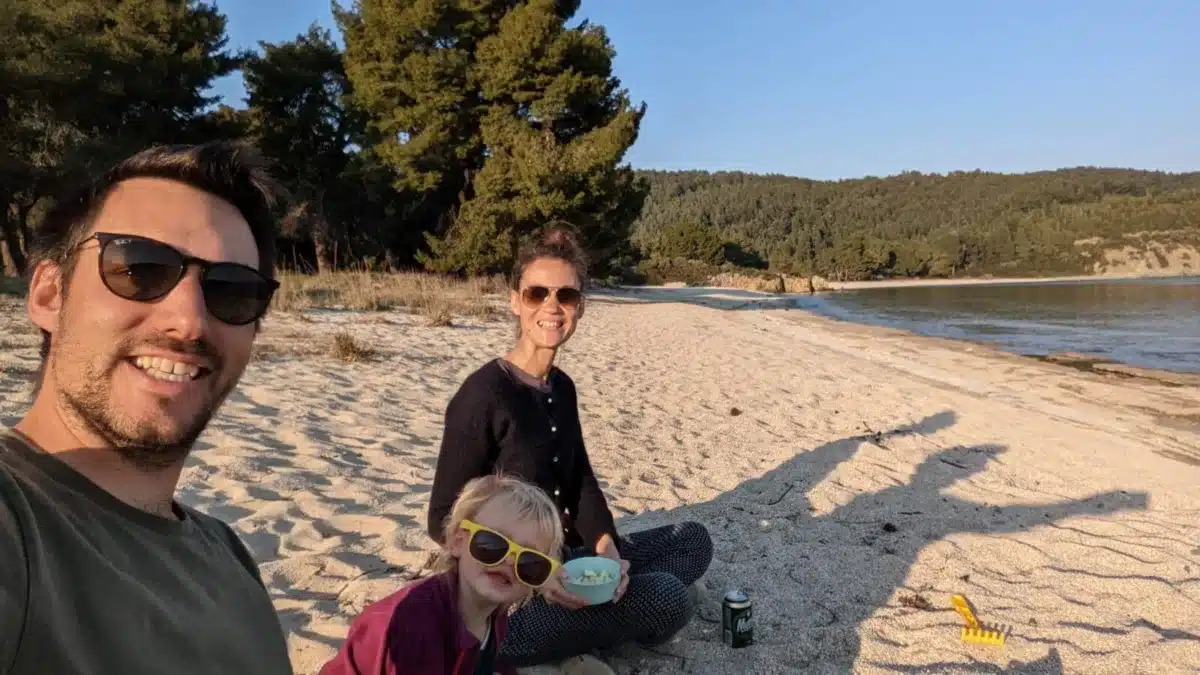
Now you know everything, or almost, we wish you an excellent preparation, put you as soon as you can!
Don’t hesitate to drop us a line below or on Instagram to let us know your departure date, share our article or ask any questions you may have – they’re usually our favorite questions, as they help us get back into this incredible adventure!



0 commentaires