



Wondering what to see and do on your road trip to the Lofoten Islands? How to get to the archipelago Where to rent a car ? You’ve come to the right place!
We visited this incredible archipelago for 1 week, and we can tell you that the scenery is simply breathtaking.
Below is our itinerary for visiting the best of the Lofoten archipelago in 7 days. On this itinerary, you’ll explore the Lofoten Islands’ most beautiful landscapes, as well as some off-the-beaten-track stops. We also give you all the information you need to reach the archipelago, plus our best addresses!
How to get to the Lofoten Islands
Where to land in Lofoten?
It’s the first question we all ask ourselves when planning a trip to the Lofoten Islands! Because it’s closer to Europe’s North Cape than it is to home.
➡️Il There are 4 airports close to the archipelago. Leknes and Svolvær airports are on the archipelago, while Tromso and Bodo airports are on the mainland.
To help you visualize the different airports, here’s an interactive map, which will be much more useful than our attempts to explain where they are!
Generally, from France, there will be a stopover in Oslo. Domestic flights from the Norwegian capital can be booked to the various airports listed above.
Bodo and Tromso (located 6 hours north of the archipelago) are the furthest away airports, and generally offer more attractive flight prices and car hire rates (already a good plan to note).
👉 Compare car rental prices in Lofoten Islands with Discover cars
Given all the possible combinations to come to the Lofoten Islands, we think it’s essential to use a flight comparator to find the best option in terms of price and journey time.
Example: price of a flight from Paris to Bodo approx. 400€ in June with a stopover in Oslo with Norwegian airlines or Scandinavian Airline.
Arm yourself with patience and a pen and paper, and find what you’re looking for!
If you arrive in Bodo, a ferry will take you to the south of the archipelago (the port of Moskenes). As mentioned in our article on how to save money in the Lofoten Islands, you can also take advantage of free ferries to and from the archipelago.
Getting around the Lofoten Islands
Firstly, public transport is virtually non-existent on the Lofoten Islands. The various points of interest and hiking trails are located away from the villages. Renting a car is the most flexible way to visit Lofoten.
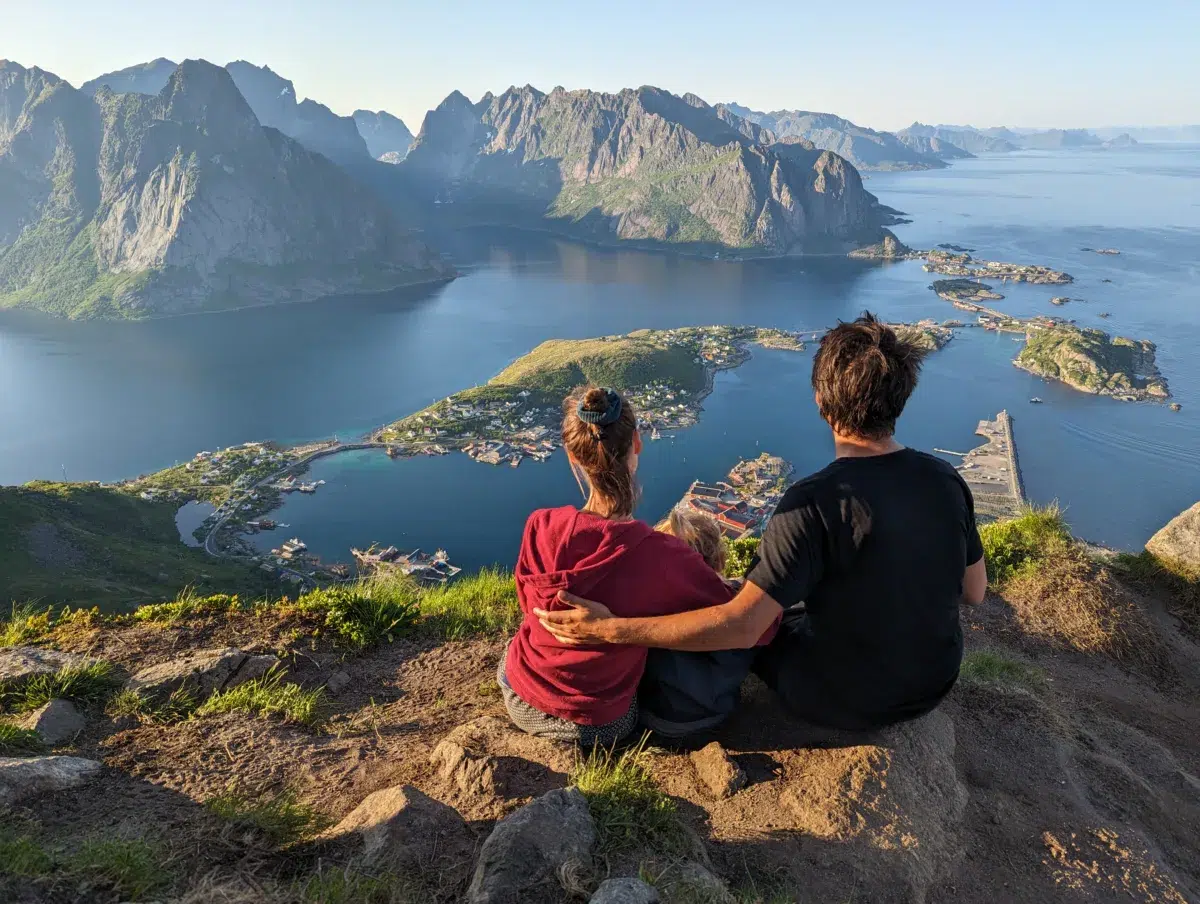
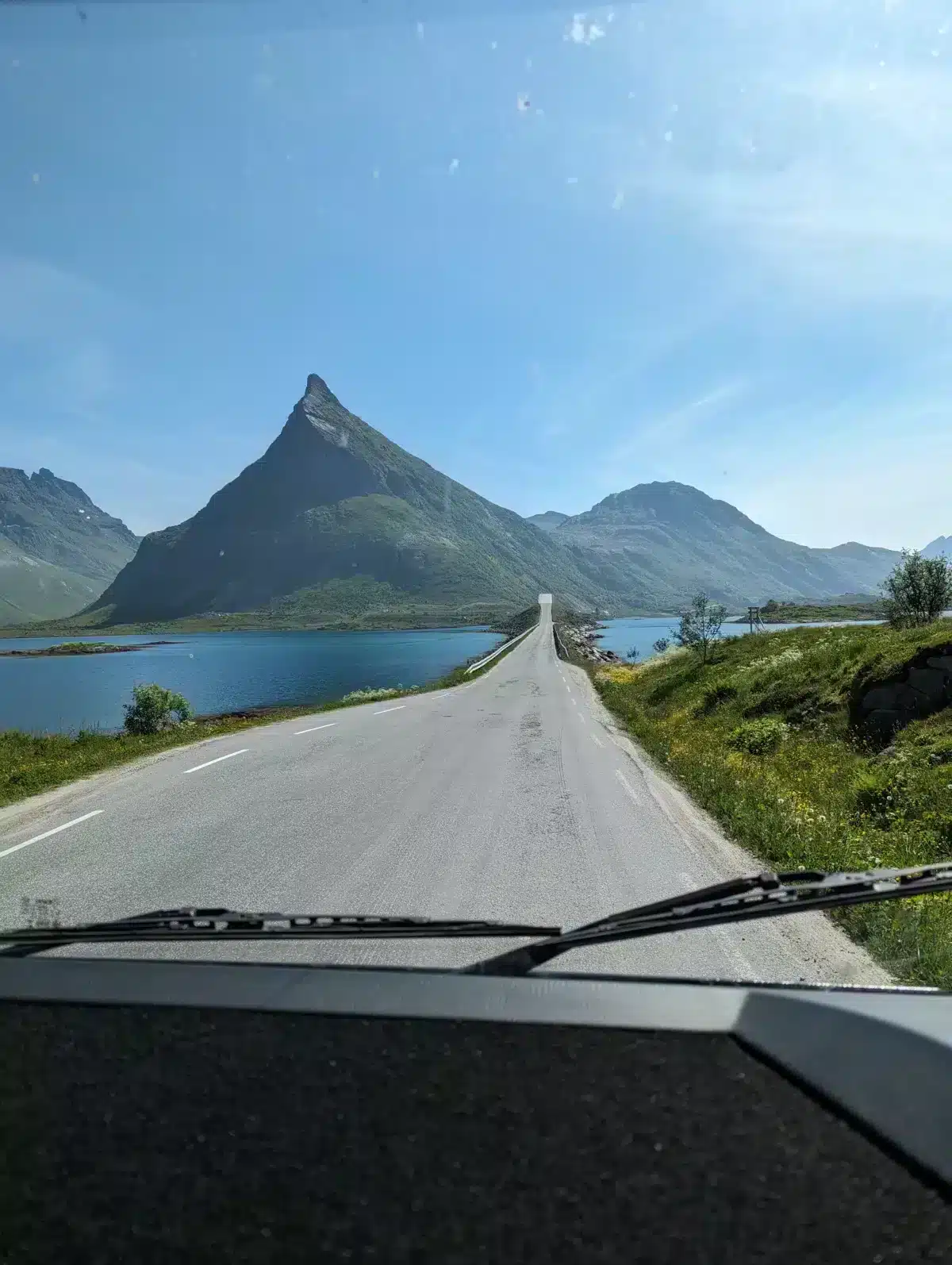
The scenic road (E10) along the archipelago is simply sublime, one of the most beautiful in Norway, so we often stopped for photo breaks.
Car rental
➡️Tous The airports listed above offer car rentals. From Tromso or Bodo, the cost of renting a small city car is around 80€ -100€ per day, which is quite a budget, but without a car it’s harder to explore the archipelago.
To write this article, we compared rental prices (yes, we had fun!) from Leknes or Svolvær airports located on the archipelago, and the prices are always higher.
We recommend a city car for easy parking and maneuvering. Roads are narrow and parking lots are generally small.
An important point to note is that driving in Norway is pleasant, even if the roads are narrow, and speed limits rarely exceed 60km / hour.
➡️Nous recommends renting a car in advance to make sure you have one during your stay! To compare car prices in Bodo or Tromso, we recommend using an aggregator, which compares the rates of a large number of rental companies.
All you have to do is enter all your criteria – dates of stay, pick-up and drop-off locations – and the site will find the best deal for you!
Generally speaking, rates are more attractive through the platforms than directly from the rental company, as the latter negotiate rates with the comparators.
After testing a number of comparators, Discover Carshas clearly become our favorite site for comparing car rental prices. The site aggregates offers from hundreds of rental companies, allowing you to quickly identify the best rate according to your criteria.
This filter lets you check at a glance :
- the amount of the security deposit
- type of bank card accepted (debit or credit)
- what is actually included in the insurance
- customer reviews for each rental company
👉 As an example, we found a car at €85 per day via Avis (excluding insurance).
🚗 Find our complete guide with all our tips for renting your car in the Lofoten Islands.

Bring your own vehicle
That’s what we did from France. If you have time, we recommend that you leave with your own vehicle or rent a converted vehicle in France.
Even if the journey to Lofoten is very long, the various roads are magnificent and there are many points of interest along the way. The outskirts of the city of Stavanger and the fjords around Bergen are sublime.
From Oslo, allow around 20 hours for the journey, which will give you plenty of time to fine-tune your itinerary!

When to come to the Lofoten Islands
Of course, like everywhere else, the Lofoten Islands offer a variety of experiences depending on the season, each with its own charms and possible activities. We give you a few ideas of things to do depending on the time of year.
- Summer (June to August): we think this is the ideal time to enjoy long days and the SUN AT MIDNIGHT, when the sun doesn’t set for several weeks. It’s also great for hiking and water sports.
- Autumn (September to November): the advantage of this period is that there are fewer visitors and the climate is still mild. From September onwards, longer nights increase your chances of seeing the Northern Lights.
- Winter (December to February): the perfect time to observe the BOREAL AURORES and to see the snow-covered villages.
- Spring (March to May): we can combine winter and summer activities such as skiing and hiking.

Where to stay in the Lofoten Islands?
To take full advantage of the picturesque villages and the many hikes and activities on offer in the archipelago, we recommend that you choose several stopping-off points, for a number of reasons.
Roads in Lofoten are narrow and speed limits are low (60km/h on average), so although distances between sights are not great, you ‘ll be travelling relatively slowly.
The archipelago is divided into 4 islands (see map below). You can choose 2 or 3 hotels/Rorbuers/apartments during your stay, for easy access to the archipelago by car.
- 1 on Vaeroy island (1 night)
- 1 on the island of Moskenes, where there’s the most to do, for easy access to Reine, hiking and the white sandy beaches of the north of the island. (3 nights)
- 1 on the island ofAustvåg, to explore Henningsvaer and Trollfjord (2 nights)
In any case, you can choose from several types of accommodation:
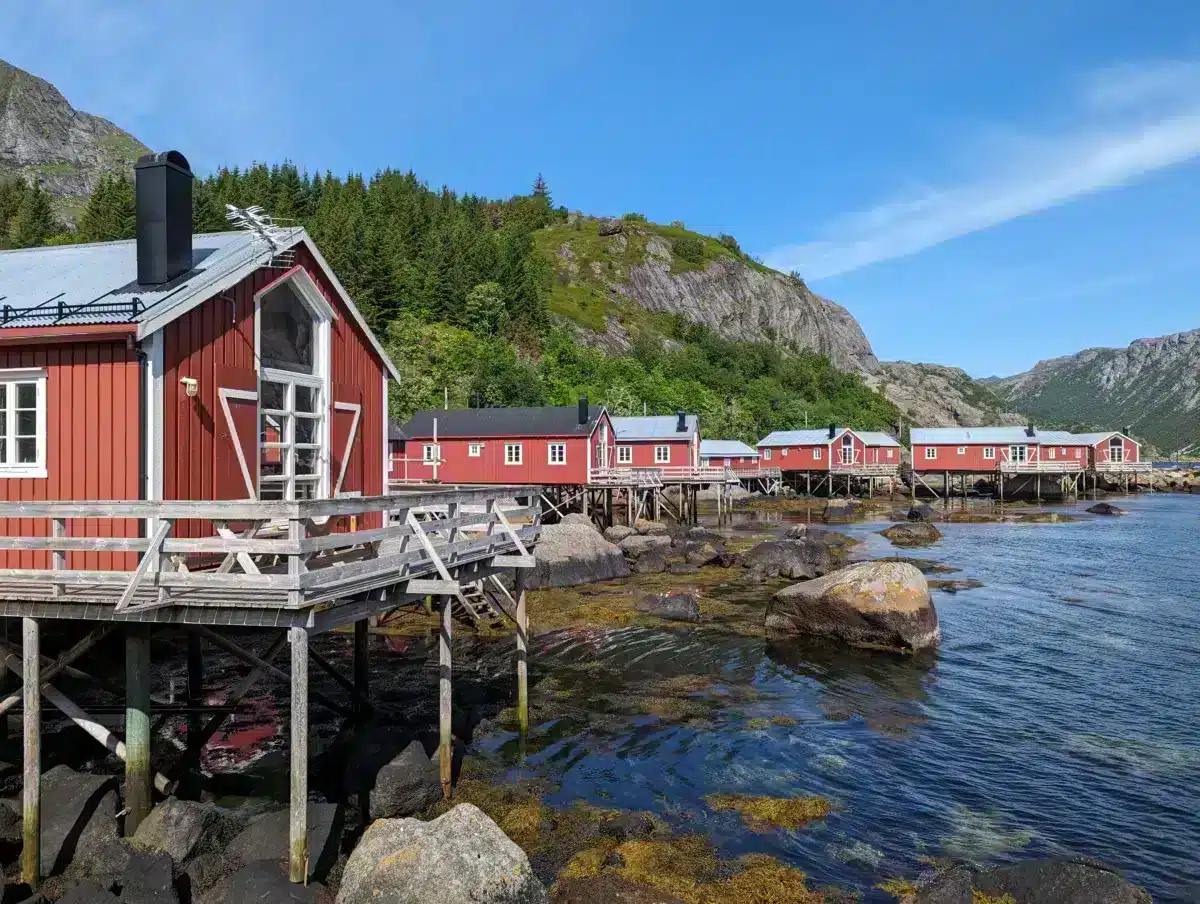
- Rorbuer: renovated, fully-equipped old fishermen’s huts (with kitchen)
- Hotel: often with shared kitchen
- Apartments: the ideal place to cook for yourself

On the Lofoten Islands, as in the rest of Norway, the cost of accommodation can be surprising. It should be noted that the cost of living in Norway is around 30% higher than in France.
To find suitable, well-located accommodation, you’ll generally need to budget around €150-€200 per night.
The closer you stay to the south of the archipelago on Moskenes Island, the higher the prices.
There’s plenty to choose from, but we recommend booking well in advance, especially in high season! Now it’s time for our selection!
➡️Nous recommends that you opt for accommodation with a kitchen, so that you can prepare your own meals and save money.
Our 2 favorites
Eliassen Rorbuer offers fully-equipped, well-renovated

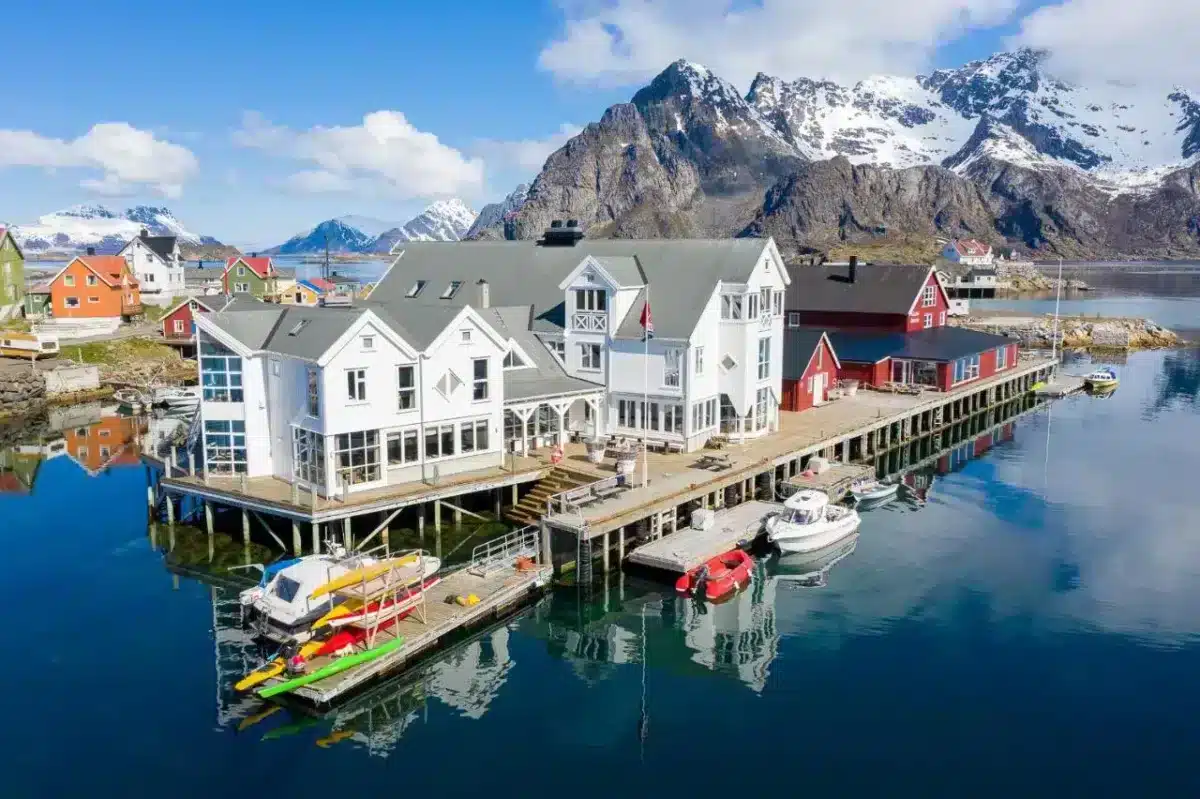
Villa Bryggekanten: superb location in the heart of the village of Henningsvær with lots of charm, tastefully decorated communal areas, charming welcome, with a very decent breakfast overlooking the water.
- On the island of Flakstad (Nusfjor, Rambergstranda…), the Ramberg Gjestegård hotel offers rooms from €100, next to two sublime beaches (+ shared kitchen).
- On the island of Moskenes (Reine, A…), Lydersen Rorbuer offers Rorbuer with access to the shared kitchen, from €70 per night.
- On the island of Austvåg: (Henningsvaer and Svolvaer…) : Fast Hotel Henningsvær offers stylishly decorated rooms with sea views from €70 per night.
Where to sleep in a camper van or van during your road trip?
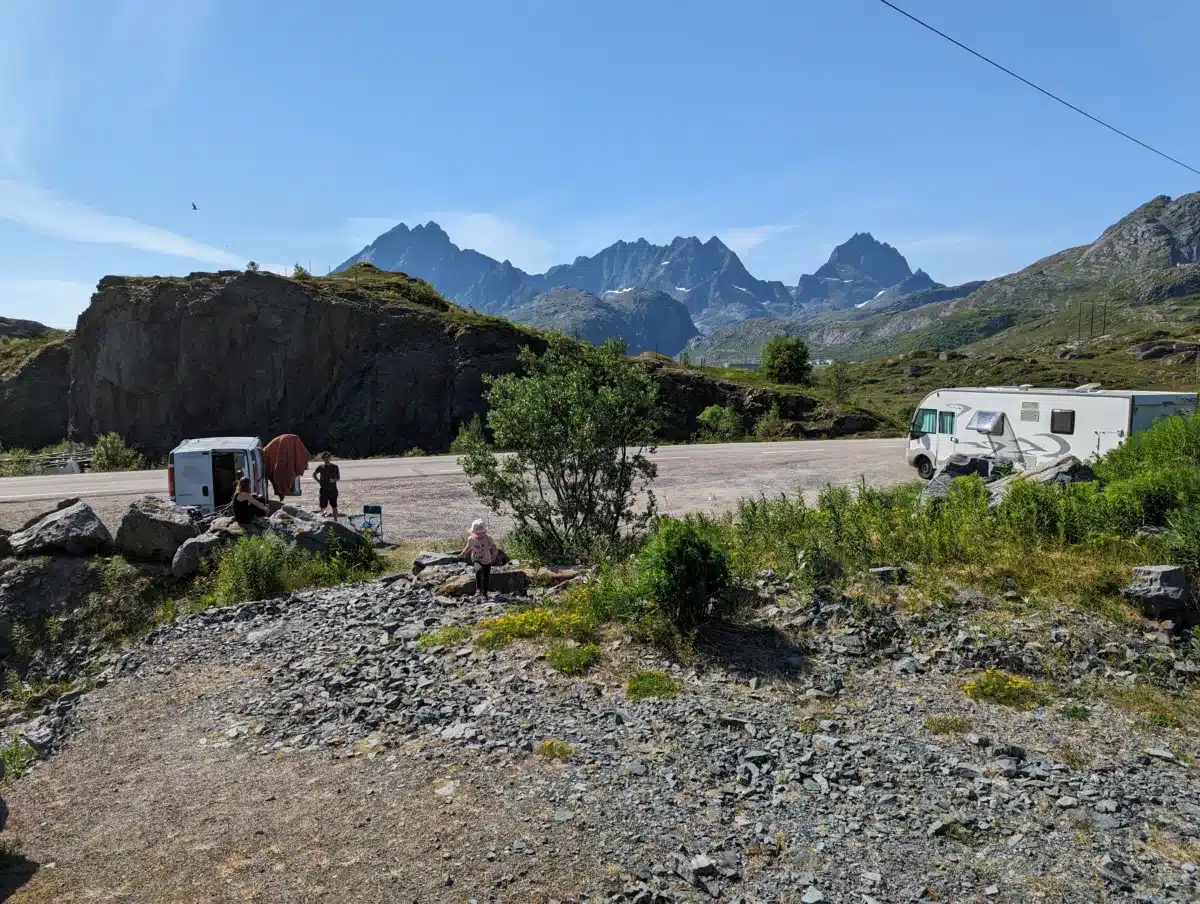
We’re not going to lie to you, the Lofoten Islands aren’t among the best places in Norway for wilderness bivouacs, as the spots are generally on the edge of the A10, which is still quite busy, and the parking lots are really small. Here are the spots where we slept during our road trip to the Lofoten Islands:
- Vaeroy : parking lot at the old airstrip (north of the island)
- Moskenes Island: park4night #131988 Sund I Lofoten, just a few places off the main road, ideal for travelling south.
- Vestvågøy island: park4night #83305, again just a few spaces off the main road, near Haukland beach
- Austvåg Island: park4night #86716, with a handy little hut for sheltering from the wind or cold in the evening.
What to see and do in Lofoten?
After more than a month in Norway, we didn’t think we’d be surprised, but we were.
There’s so much to see in the Lofoten Islands, we’ve also put together a top 10 list of the most beautiful landscapes to see in Lofoten, which you can view here.
Geographically, the archipelago is made up of several islands:
- Moskenes Island (A and Hamnoy) yellow area on our map
- Flakstad Island (Nusfjord, Flakstad, Ramberg…) pink area on our map
- Island of Vestvågøy (Stamsund, Ballstad, Leknes…) blue area on our map
- Austvåg Island (svolvaer, Henningsvaer…) purple area on our map
- The islands to the south: Værøy and Røst

In short, the things to see are concentrated in the south of the Lofoten Islands:
- Hiking: this is the activity to do on the Lofoten Islands, as there are so many possibilities. You can visit the Alltrails website to find out about all the hiking opportunities on the archipelago. Our favorite is the hike from Reinebringen to the summit, where the view is incredible.
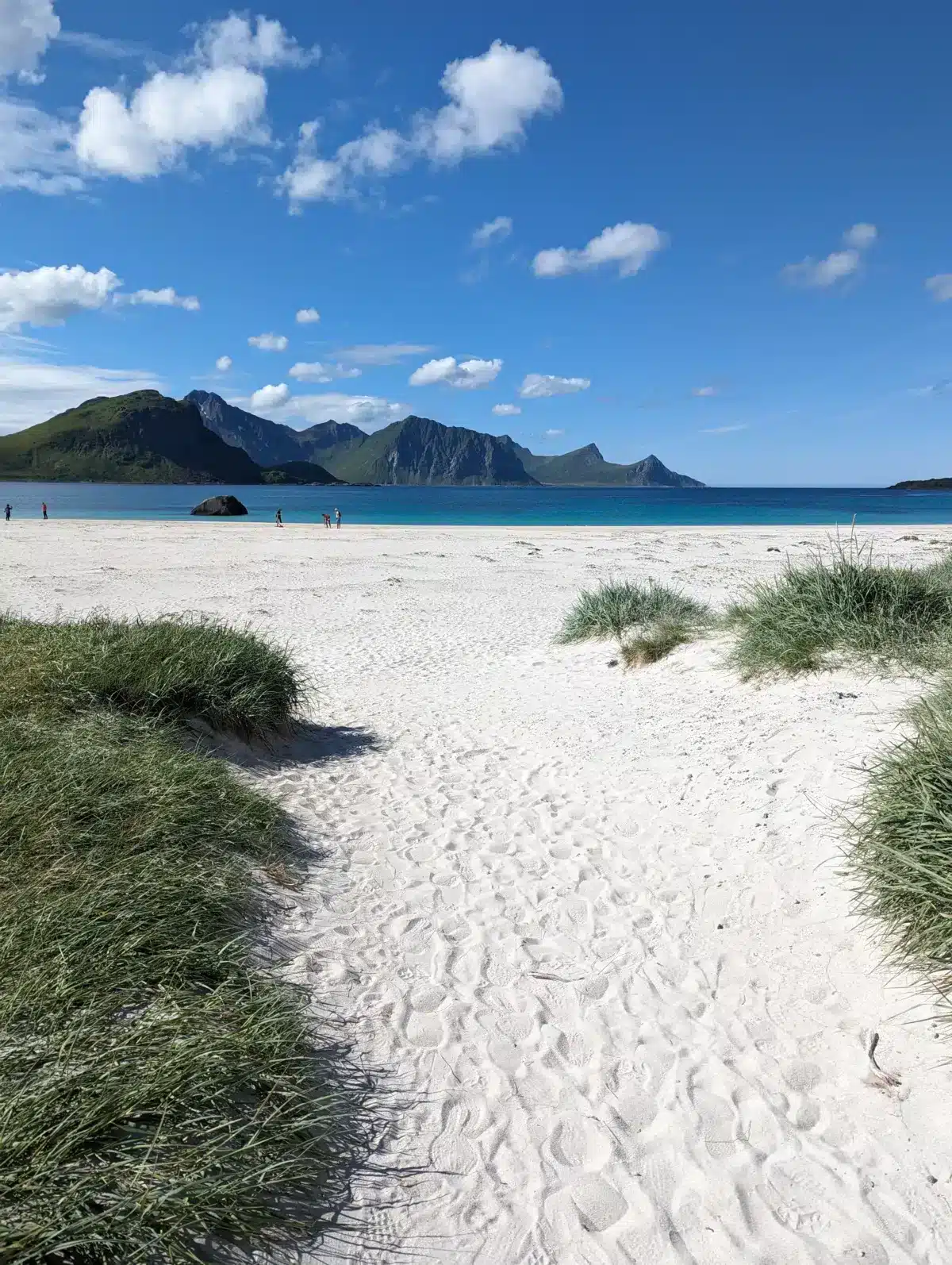
- Beaches : you’re probably wondering why we’re talking about beaches when the archipelago is located above the Arctic Circle, because there are several large white sandy beaches dotting the archipelago. Don’t get carried away, the water temperature doesn’t exceed 10 degrees in midsummer.
- Villages: picturesque villages with small red fishermen’s huts (Rorbuer) such as Reine, A, Henningsvær, and Nusfjord, each offering a captivating glimpse into the fishing traditions and breathtaking landscapes typical of Arctic Norway.
- Photography: this is a paradise for photography enthusiasts, where you can capture the natural beauty of the northern lights and the midnight sun.
The best spots on our interactive map
Use our interactive map to find all our recommendations for activities, restaurants and accommodation on the Lofoten Islands.
A few tips to help you plan your itinerary
➡️Conseil 1: given the unpredictable weather on the Lofoten Islands, even in the summer months, it’s a good idea to allow two extra days without planned activities. This will allow you to adapt to weather conditions and ensure that you can carry out all the activities on your itinerary.
➡️Conseil 2 : in summer, plan to visit touristy places like Reine or the Kvalvika hike in the evening, as the sun never sets and you’ll be able to enjoy the peace and quiet of the area to the full!

Detailed itinerary of our 7-day road trip to the Lofoten Islands
Day 1. Bodo: a day of preparation
Day 2. Vaeroy, the island off the beaten track
Day 3. A and Reine villages to admire the midnight sun
Day 4. Sakrisoy, Hamnoy and Kvalvika beach
Day 5. Offersøykammen hike andHaukland beach
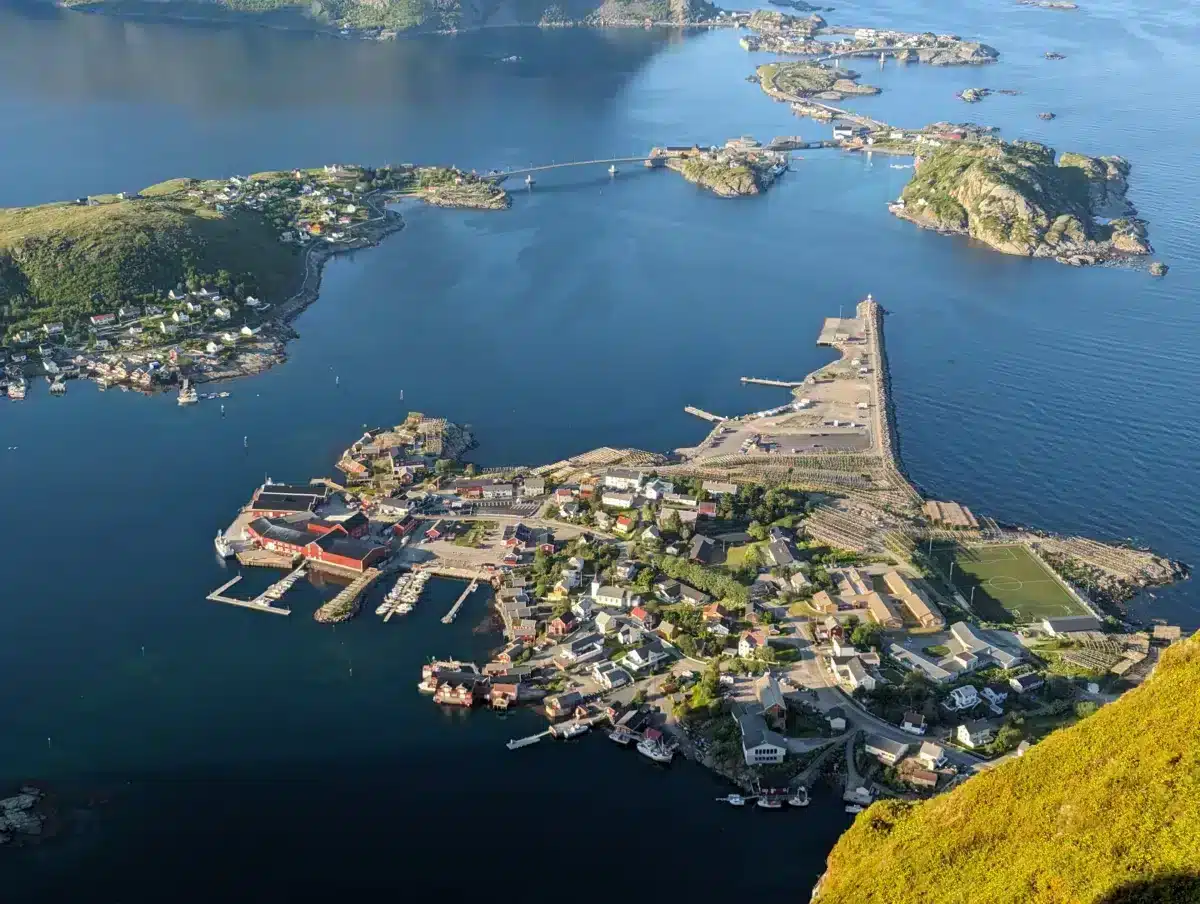
Day 6. Henningsvær, the archipelago’s most famous soccer field
Day 7. Svolvaer boat safari + return to Bodo
If you still have a few days of vacation left, we recommend adding 2 or 3 days on the island of Senja, nicknamed the Lofoten Islands’ little sister.
🎁 A great way to explore the Lofoten Islands
The Lofoten Islands are particularly well-suited for a road trip, but planning your trip requires booking your stops, accommodations, and car rental well in advance, especially during peak seasons.
If you want to explore the Lofoten Islands without spending hours planning the logistics, you can turn to Tourlane. Your trip will be custom-designed based on your dates, budget, and travel style.
You can also send them our articles and our itinerary for the Lofoten Islands to show them the places you’d like to include in your trip.
You’ll get a €100 discount when you book your trip through our link (even if you don’t follow our itinerary).
❗ Be sure to include Why Not Uswhen answering question 2 “Which creator recommended Tourlane to you?”to receive the €100.
👉 Create your own custom trip to the Lofoten Islands with a €100 discount
Bodo: preparation day
We arrived via southern Norway. If you land in Bodo, after collecting your car, we recommend you go shopping in a supermarket. We recommend the XExtra supermarket chain.
If you have time, we recommend a visit to the Saltstraumbrua bridge (south of Bodo) to observe the maelstroms (marine whirlpools), a natural phenomenon caused by the tide rushing through a narrow passage.

Afterwards, you can either take a ferry to the sublime island of Vaeroy (departure at 5.15pm or 5.30am, FREE FERRY) or directly to the port of Moeskenes, located on the archipelago, where several ferries leave from 3am to 7pm (approx. €70 for 1 car and 2 passengers).
➡️ GOOD PLACE: If and only if you make a stopover in Vaeroy, both ferry trips are FREE. It’s a pretty incredible option, considering that Vaeroy Island is one of our favorite Norwegian islands, where you can enjoy sumptuous hikes almost on your own! Official Torghatten website for timetables and bookings.
Vaeroy: the Lofoten Islands off the beaten track
We discovered this island in the south of the archipelago by talking to other travelers. It’s a small, completely unspoilt part of the archipelago. If you like to get off the beaten track, this is the island for you.
We fell in love with this small mountainous island just 8 kilometers long.
What to do in Vaeroy
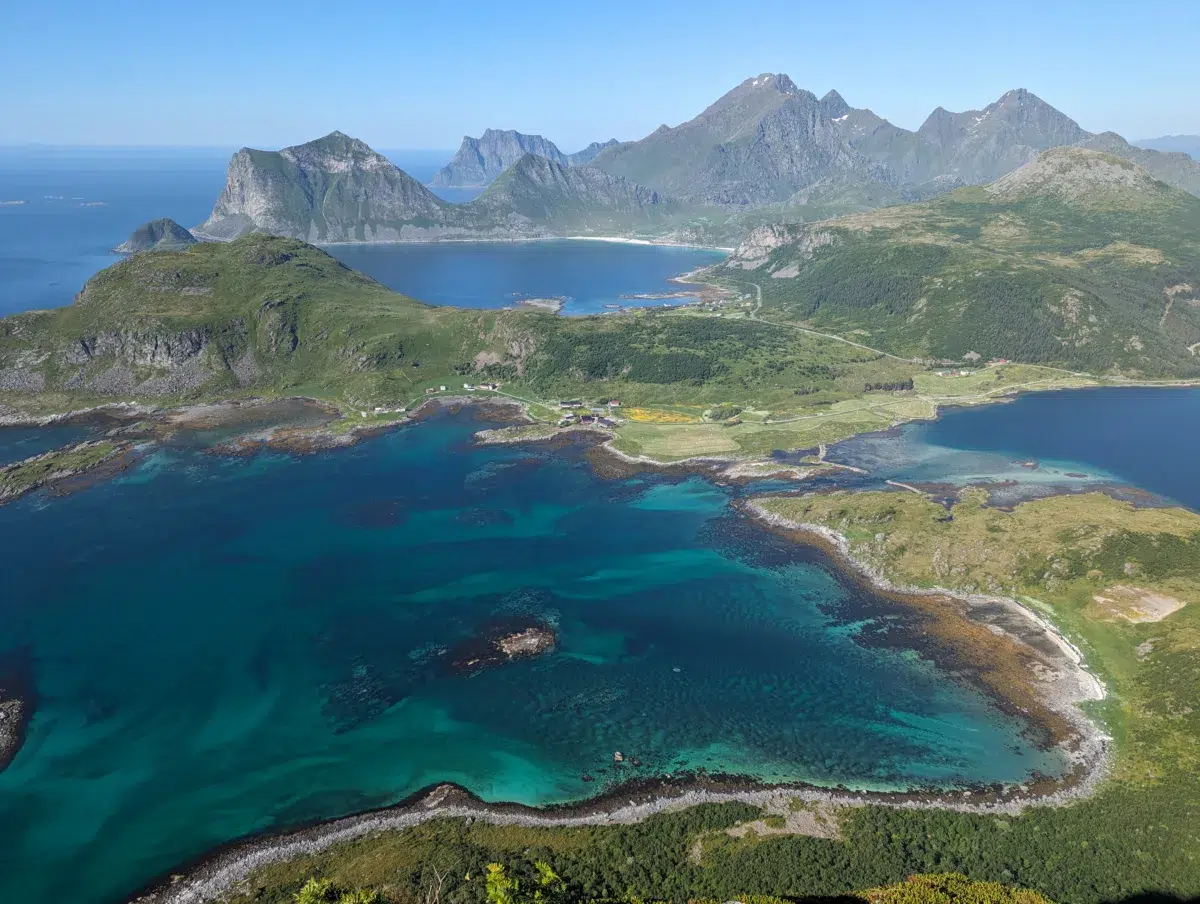
- Haen hike (topography: 5km AR D+ 600m), as always in Norway, to get to the top of a mountain, it’s simple, it’s straight ahead, so it goes up a lot at once. On reaching the top, we were rewarded with a 360-degree view of Vaeroy Island, its white sandy beaches and crystal-clear sea. We then walked along the ridge to another viewpoint next to the NATO radar station. Free parking at the trailhead.
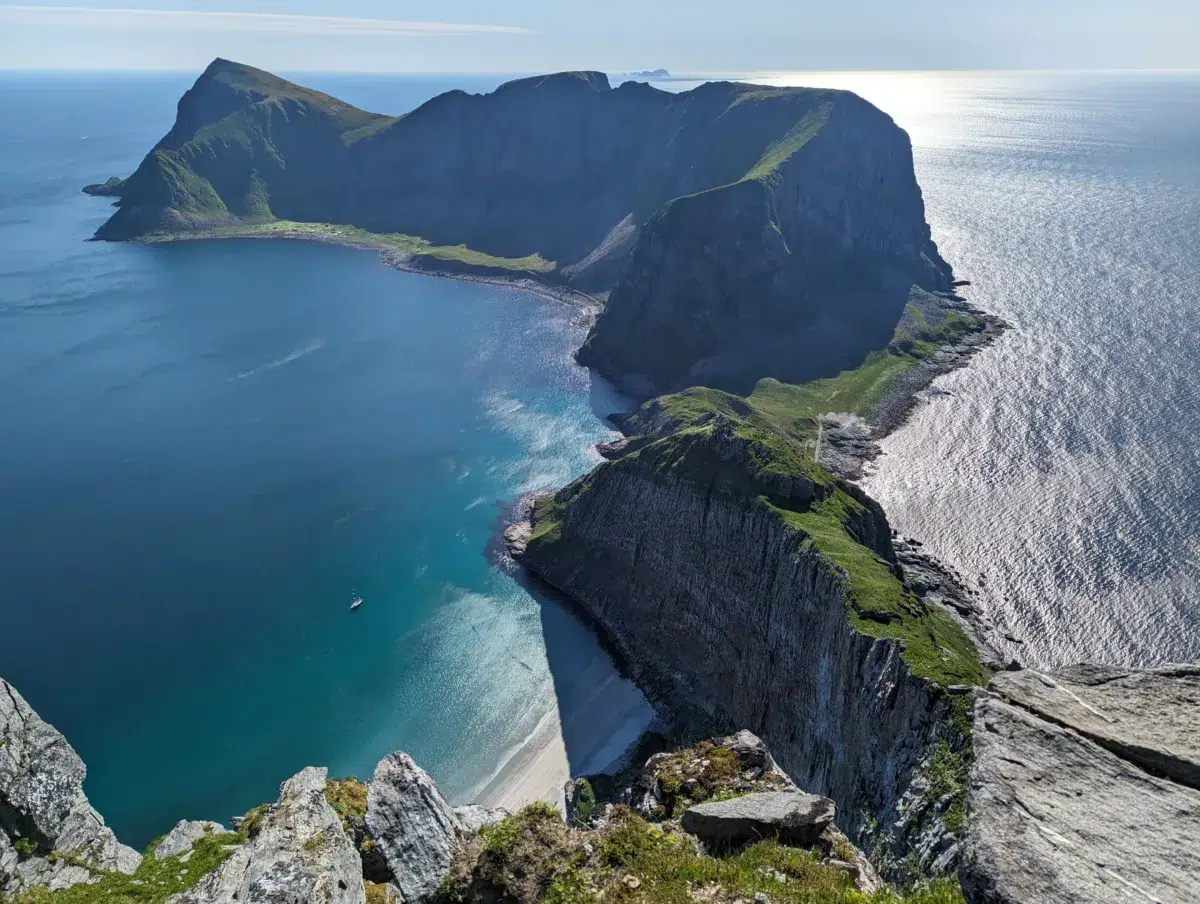


- White sandy beach next to Heimretussen viewpoint


By car, you can sleep in the parking lot on the old airstrip or pitch your tent nearby.
You can rent one of the accommodations available on the island on Airbnb, or you can take the 10:45 pm boat directly to Moskenes and sleep nearby.
We advise you to book well in advance, as the island is very small and the range of accommodation is limited, but this Lofoten Vaeroy Bryggehotell hotel offers rooms conveniently located for touring the island. We recommend the Airbnb website to find what you’re looking for!
Admire the midnight sun at Reine
We took the first ferry to reach the port of Moskenes on the island ofthe same name 1.5 hours later, in bright sunshine. You’ll see that we often talk about the weather on this itinerary, because in Lofoten it’s a real subject, and you have to adapt to very changeable weather.
Å: the traditional village of the Lofoten Islands
We went straight to the village of Å (pronounced O), the southernmost village on the island, 30 minutes from the port.
What to do in A?
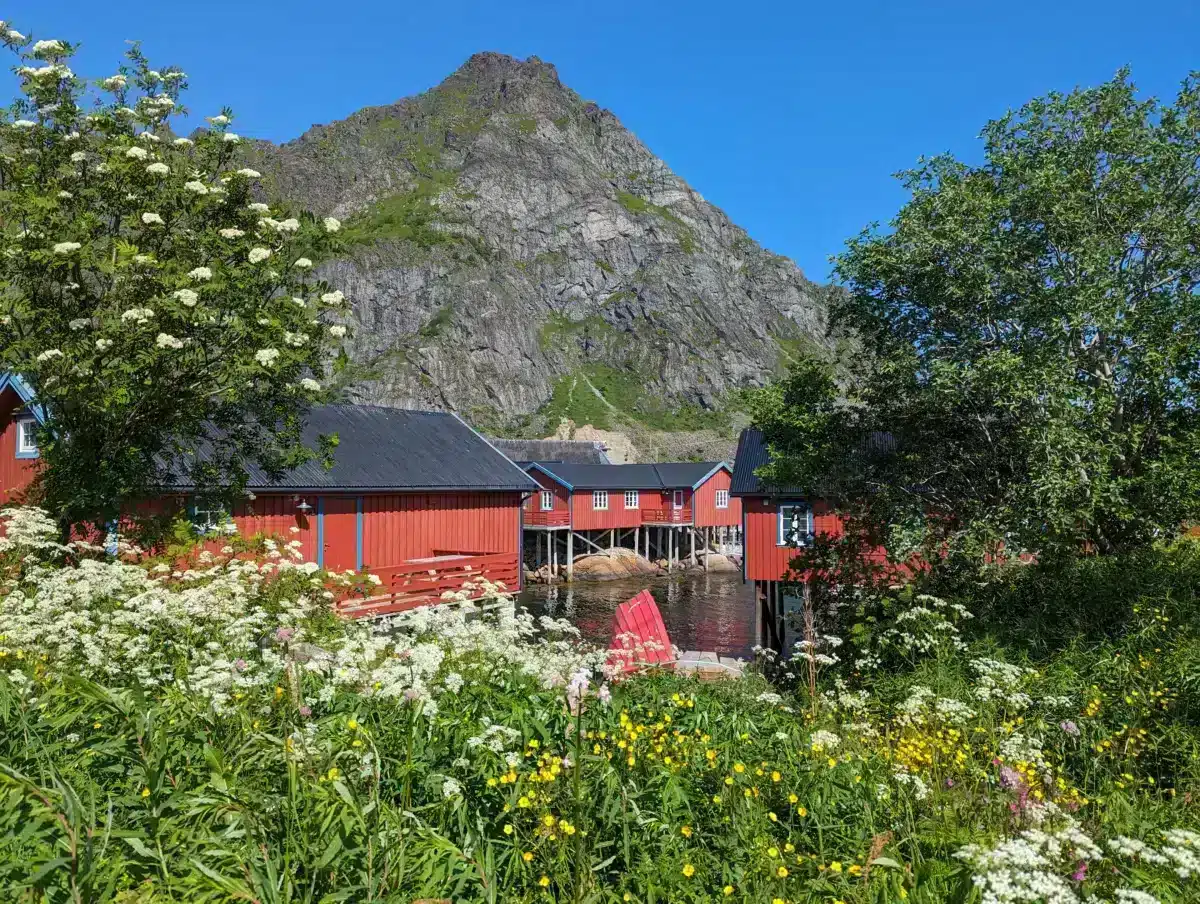
- Explore the village: we strolled around the port with its red houses on stilts surrounded by translucent water. Cod fishing is one of the island’s main activities, and the wooden cod dryers are empty at this time of year. So you don’t have to worry about the strong smell in spring. For a very touristy village, we were pleasantly surprised, as it’s rather quiet.
- Eat an excellent cinnamon roll in the village’s only bakery (€5 each)!
A large free parking lot is located just beyond the tunnel.


Village de Reine and THE must-do hike on the Lofoten Islands
In our opinion, it’s one of the most beautiful villages on the Lofoten Islands, and we’ve devoted an article to helping you organize your visit to Reine, which you can read here. Here are some quick things to do in Reine:
- Reinebringen hike: the trail itself isn’t very interesting – it’s a succession of around 2,000 steps – but the view at the top is absolutely amazing! Ideally done at the end of the day, we left around 7pm.
Topography 4km 2h return 400m D+ – free parking along the A10 motorway


- Admire the midnight sun (or northern lights in winter) at Reine village: this is really the thing to see at Reine village, so we set up at the entrance to the village (dot on our map) and took plenty of photos. We enjoyed this magnificent panorama almost on our own at this late hour.
➡️Pour If you’d like to be accompanied to bring back some great photos, we offer guided photo excursions.
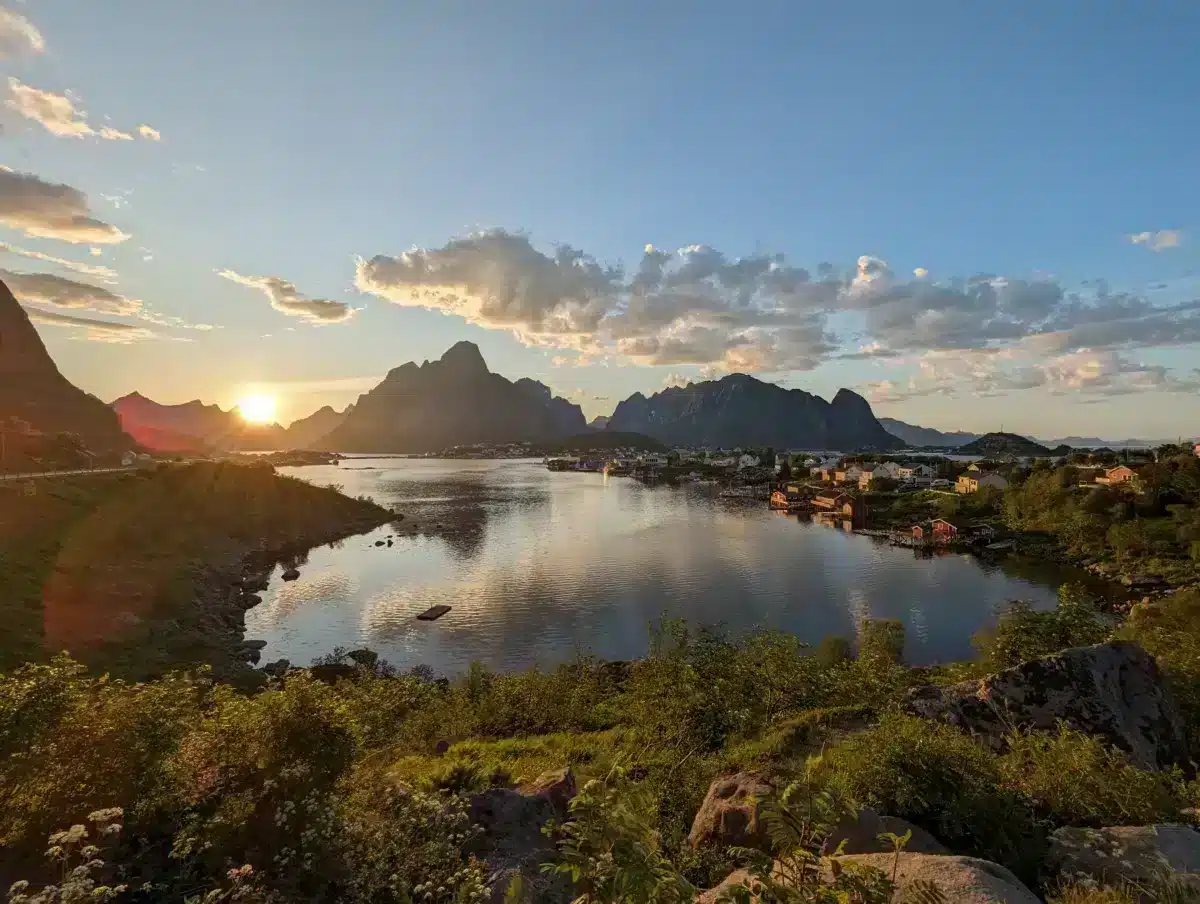
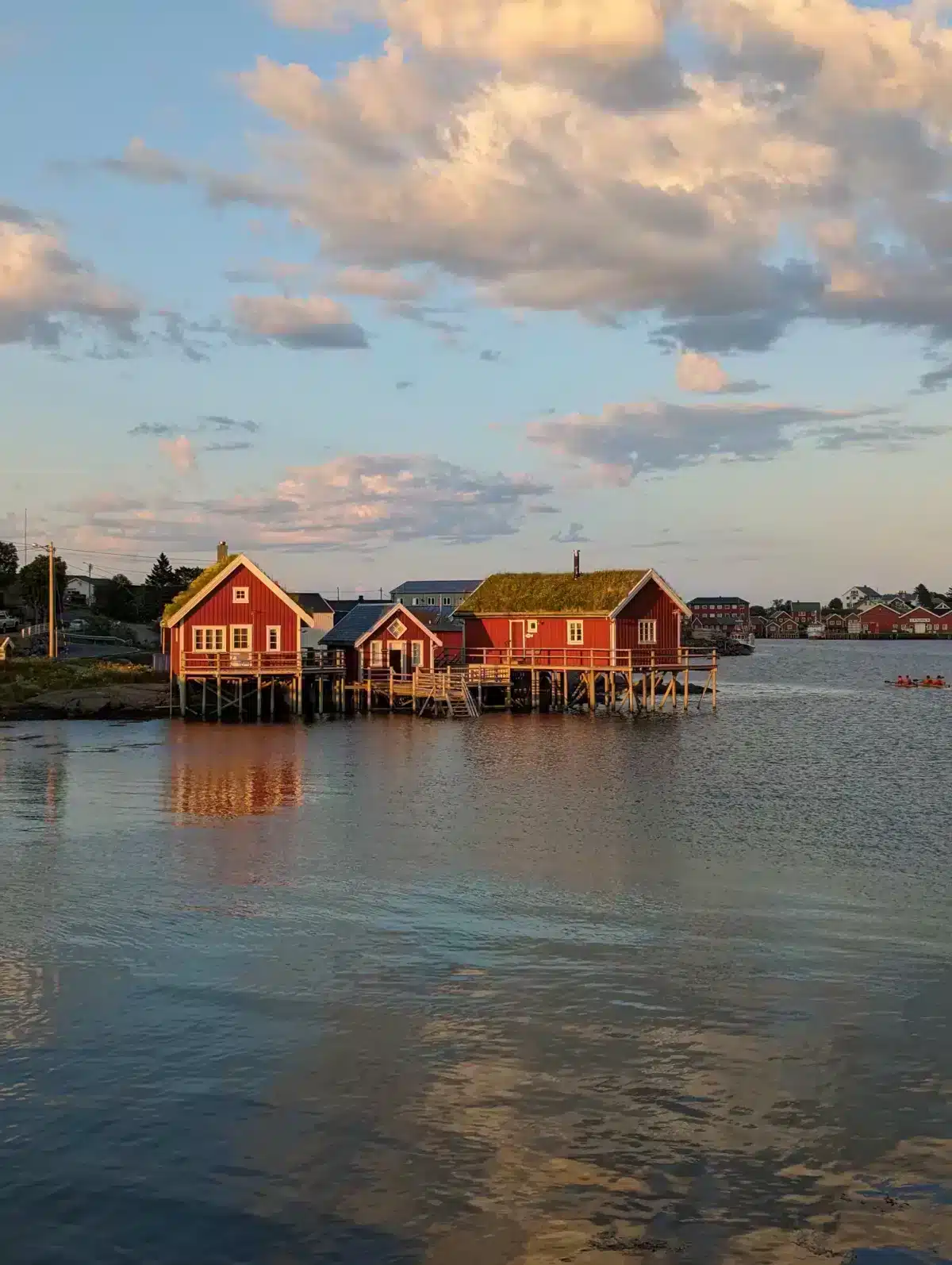

- View of the fjords: Eliassen Rorbuer from the magnificent Rorbuers in the village of Hamnoy
- Good value for money: Lydersen Rorbuer offers Rorbuer rooms with shared kitchen access, from €70 per night.
Sakrisoy, Hamnoy and Kvalvika beach
For this 3rd day, we recommend staying in the southern part of the Lofoten Islands to explore 2 photogenic spots and the famous white-sand beach of Kvalvika.
We had very foggy weather in the morning, completely spoiling visibility, but fortunately the skies cleared in the afternoon.
- Sakrisoy is famous for its photogenic yellow hut, thanks to the vertiginous peak in the background. Once there, you can take advantage of the opportunity to taste dried fish at Anita’s Sjømat .

- Hamnoy is yet another small village on the archipelago, and its location is another special feature: this tiny fishing village is overlooked by an impressive cliff. It’s an ideal place to sleep.


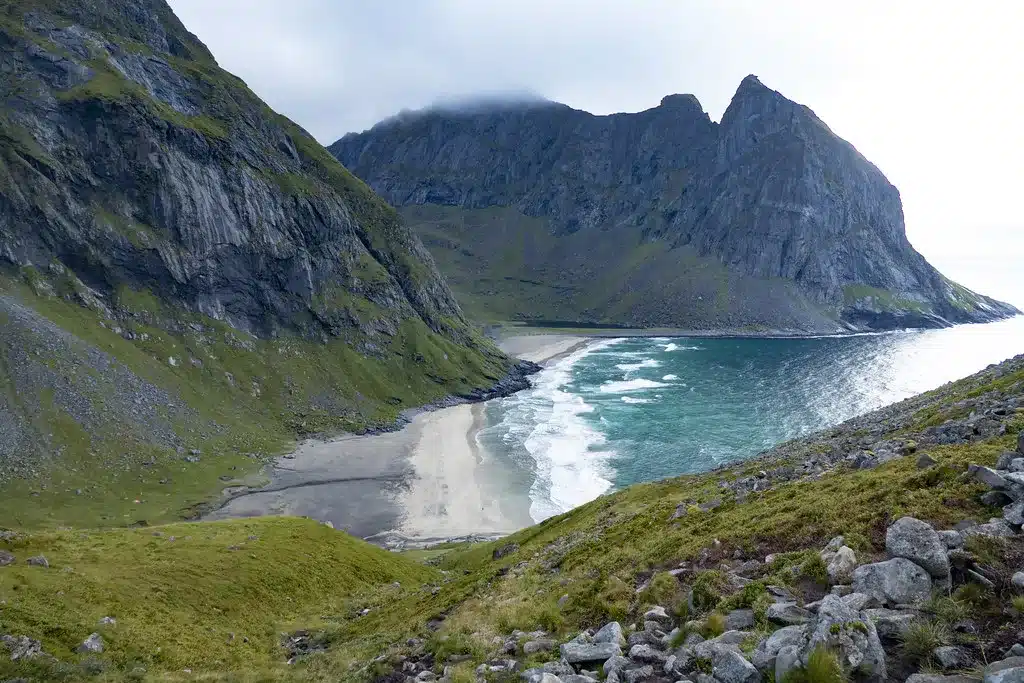
- To round off the day, we recommend a hike to the white sandy beach of Kvalvika. Yes, another hike, because in the Lofoten Islands, to take in even more of the view, you have to get up high!
Accessible only on foot, this secluded beach is framed by majestic mountains. The view from the top of Ryten over Kvalvika beach is one of the most beautiful (and best-known) in Lofoten.
Topography 7 km round trip and 600m of D+ – about 4 round trips – small free parking area at the start of the hike (we advise you to get there very early or very late)
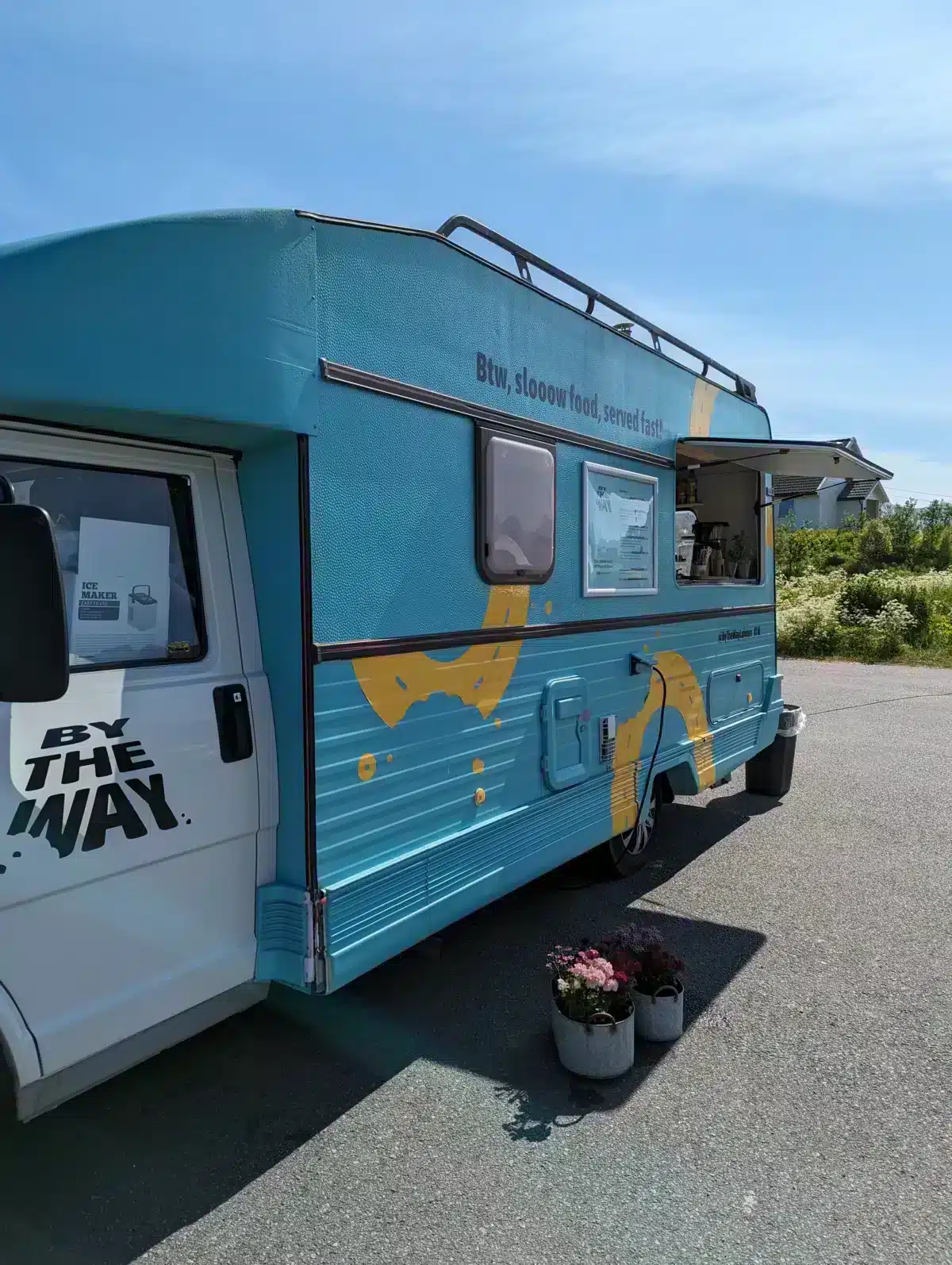
Lunch in a blue By The Way Lofoten food truck, where we eat delicious sandwiches. We recommend++.

Offersøykammen hike and Haukland beach
On this 4th day, the weather is sunny, and we drive along the coastal road to the north of the island, to enjoy the pretty white sandy beaches of Rambergstranda and Flakstad. Then it’s on to theOffersoykammen hike.
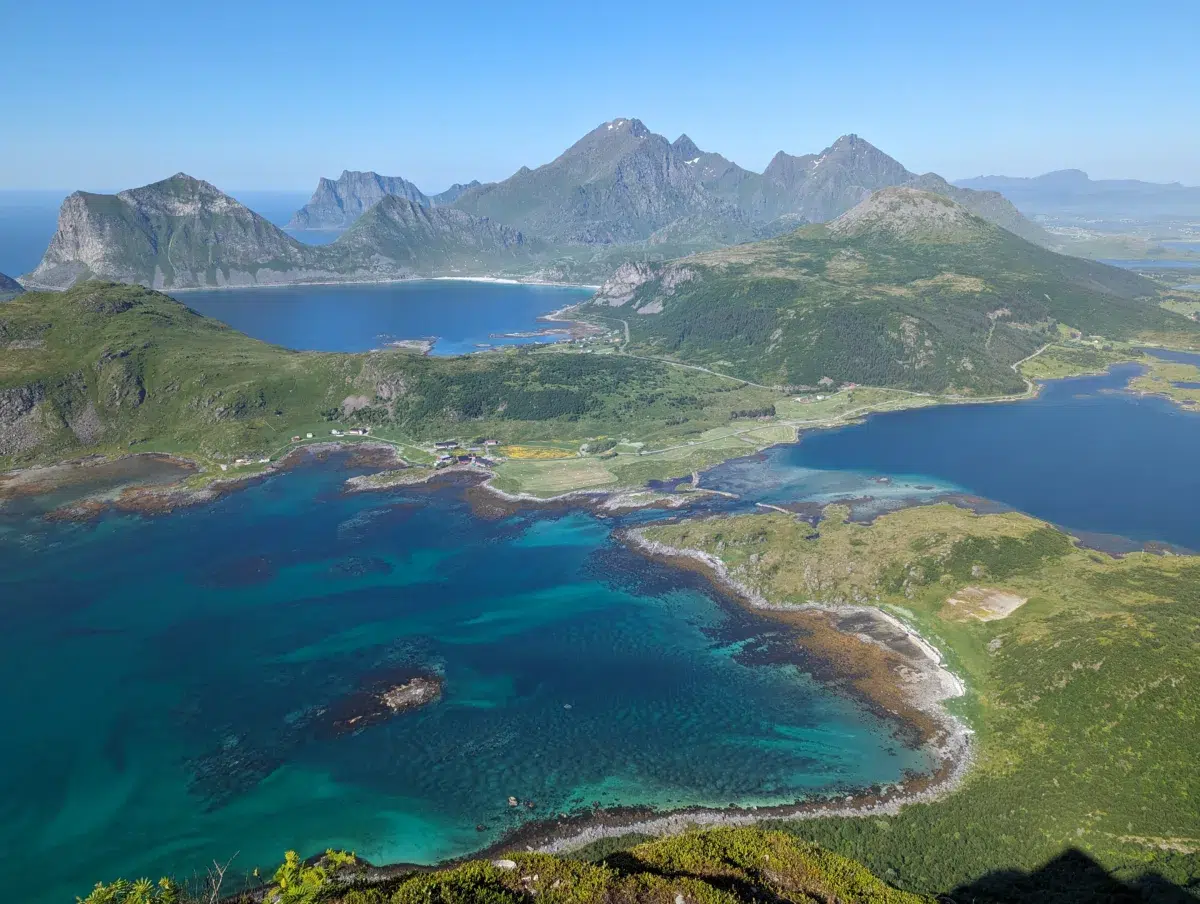
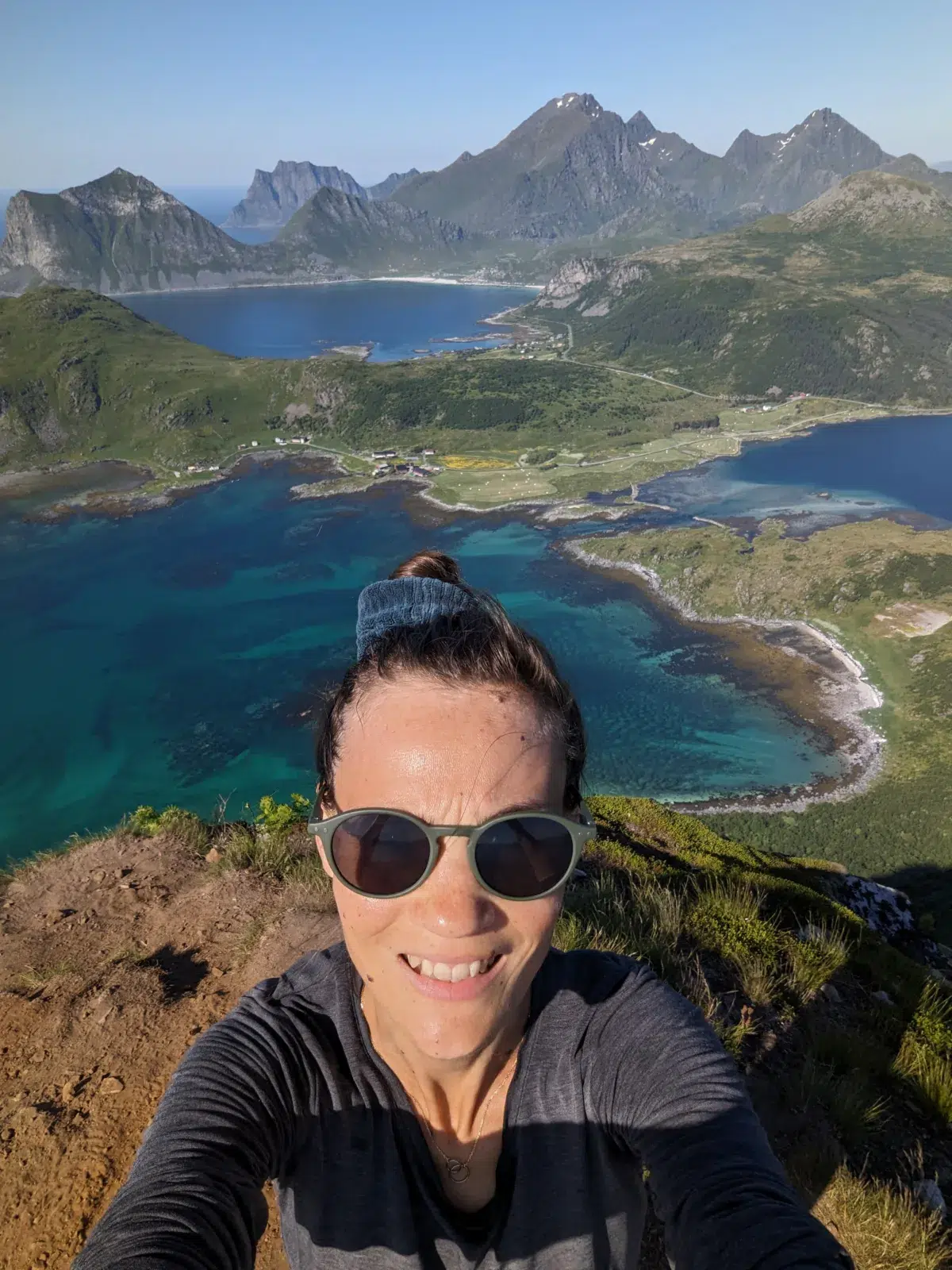
- Offersoykammen: We decide to tackle a very popular hike in the archipelago. As is often the case in Norway, it’s straight onto the summit, no detours, 1km of rocky ascent, the path unmarked. But the view is incredibly beautiful. We are dazzled by the beauty of these natural landscapes. Nature’s way of doing things.
PS: don’t forget to match your scrunchie to the color of the water.
2km return 410m D+ Difficult Free parking at the start.

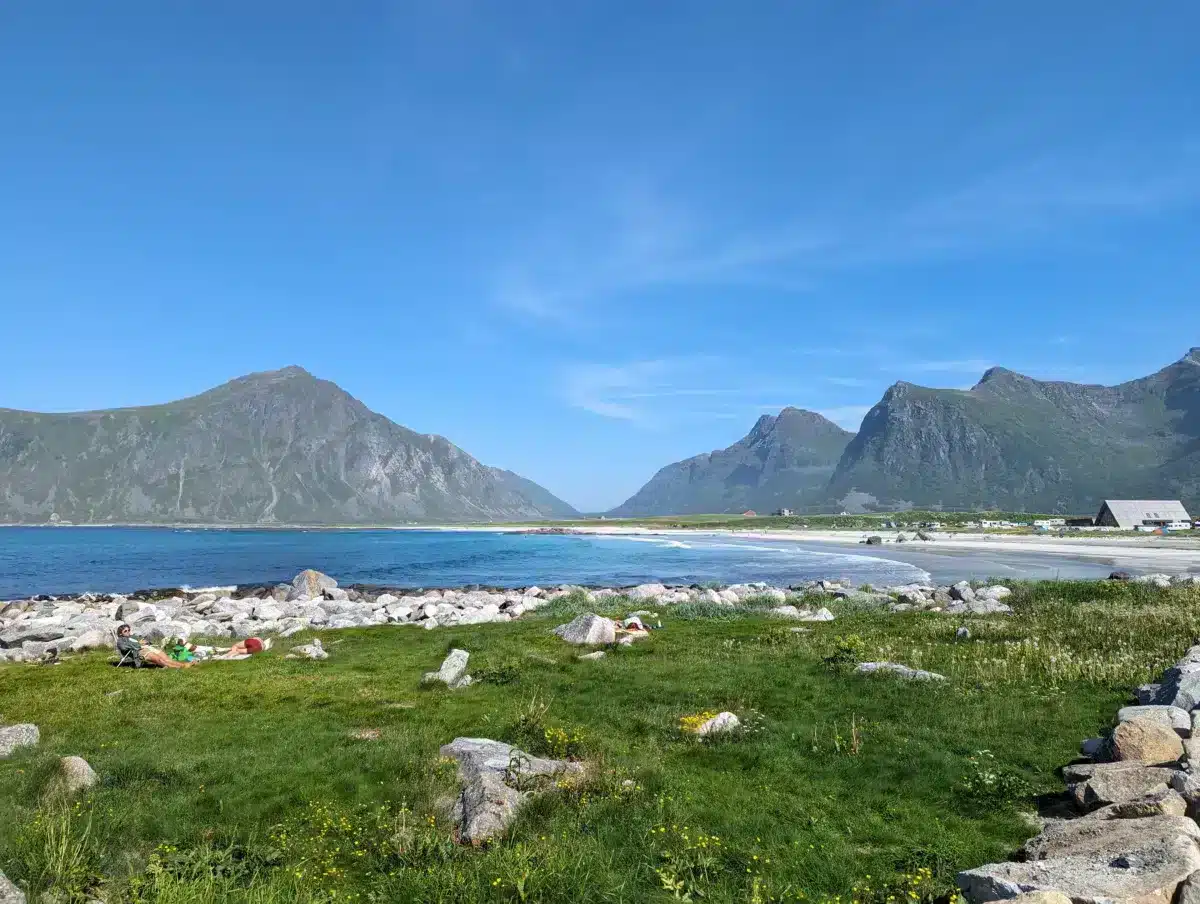
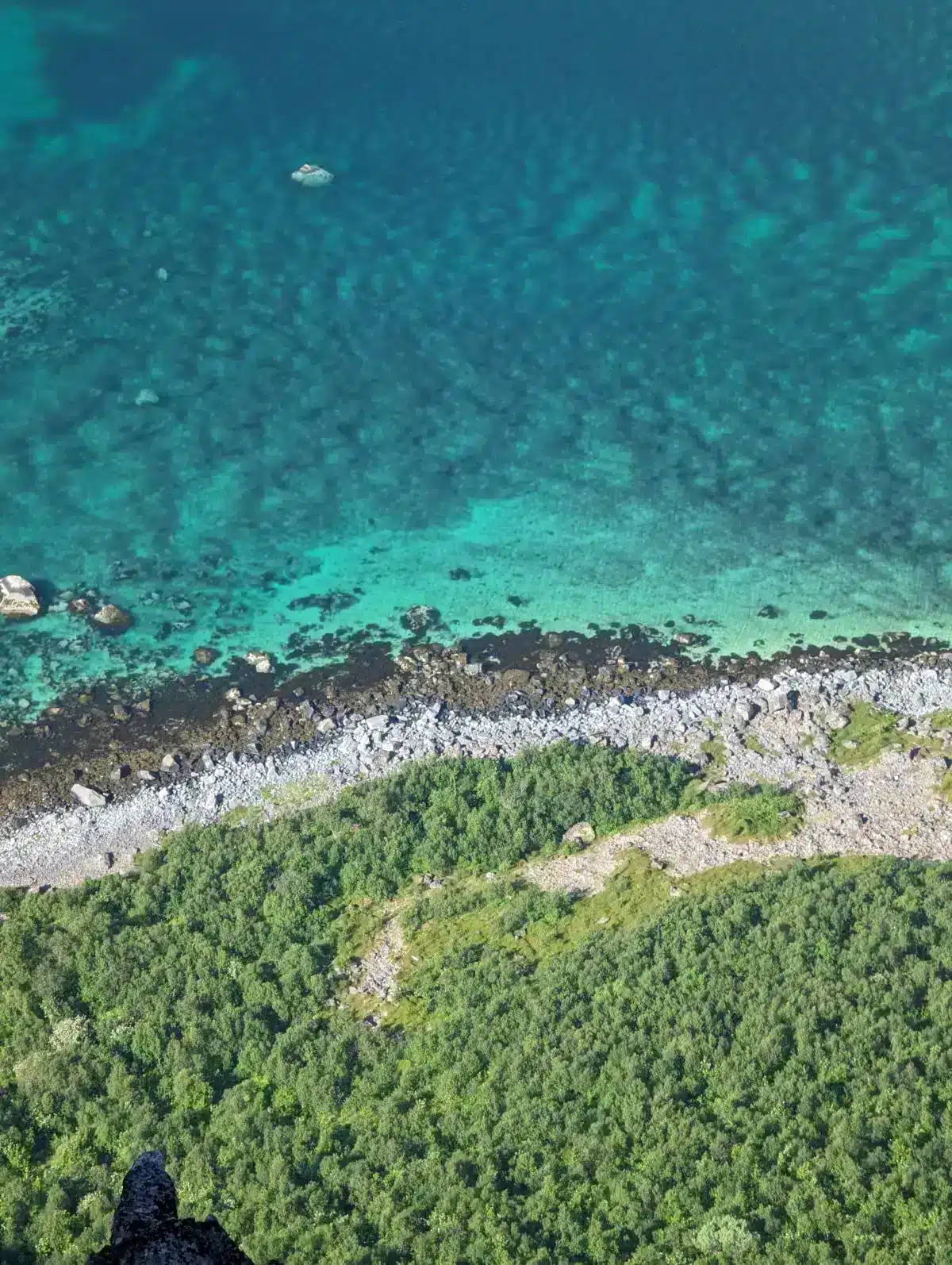
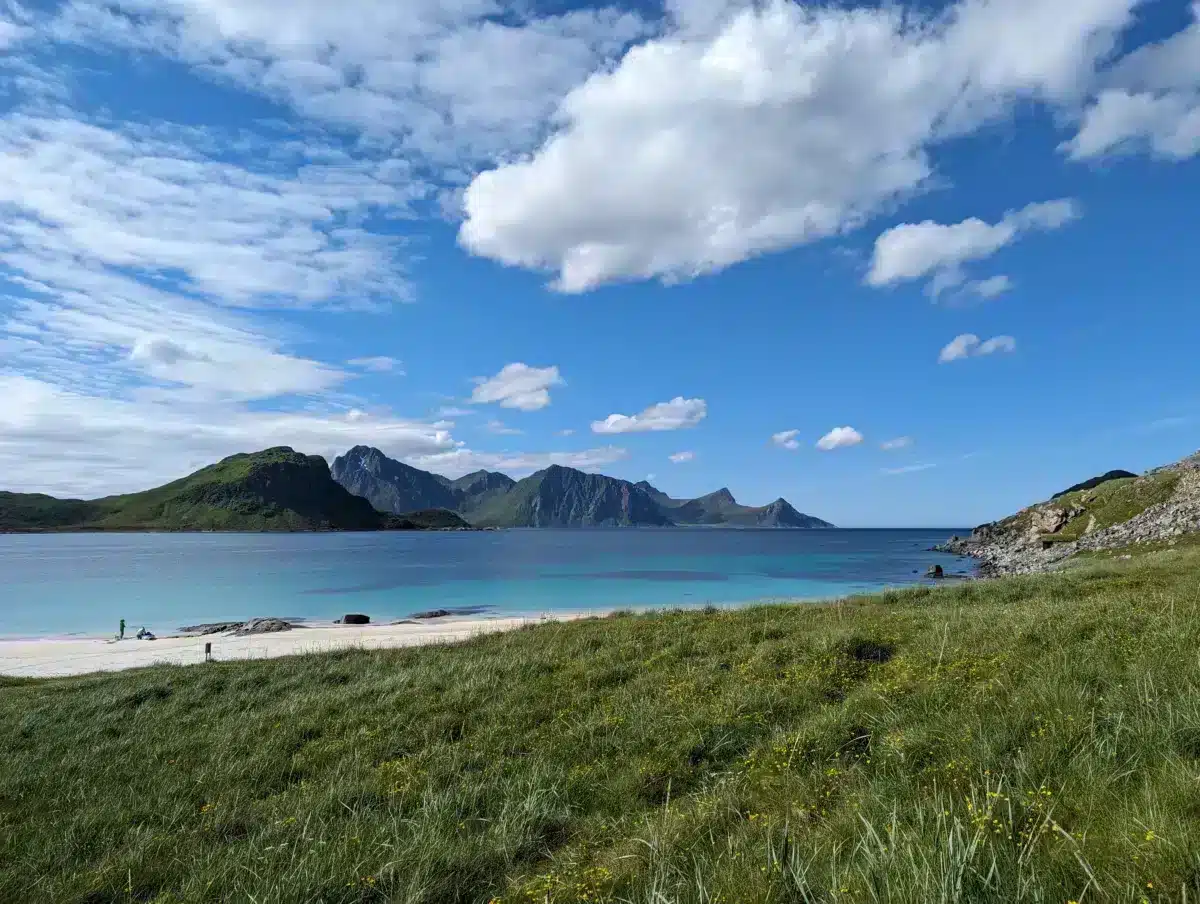
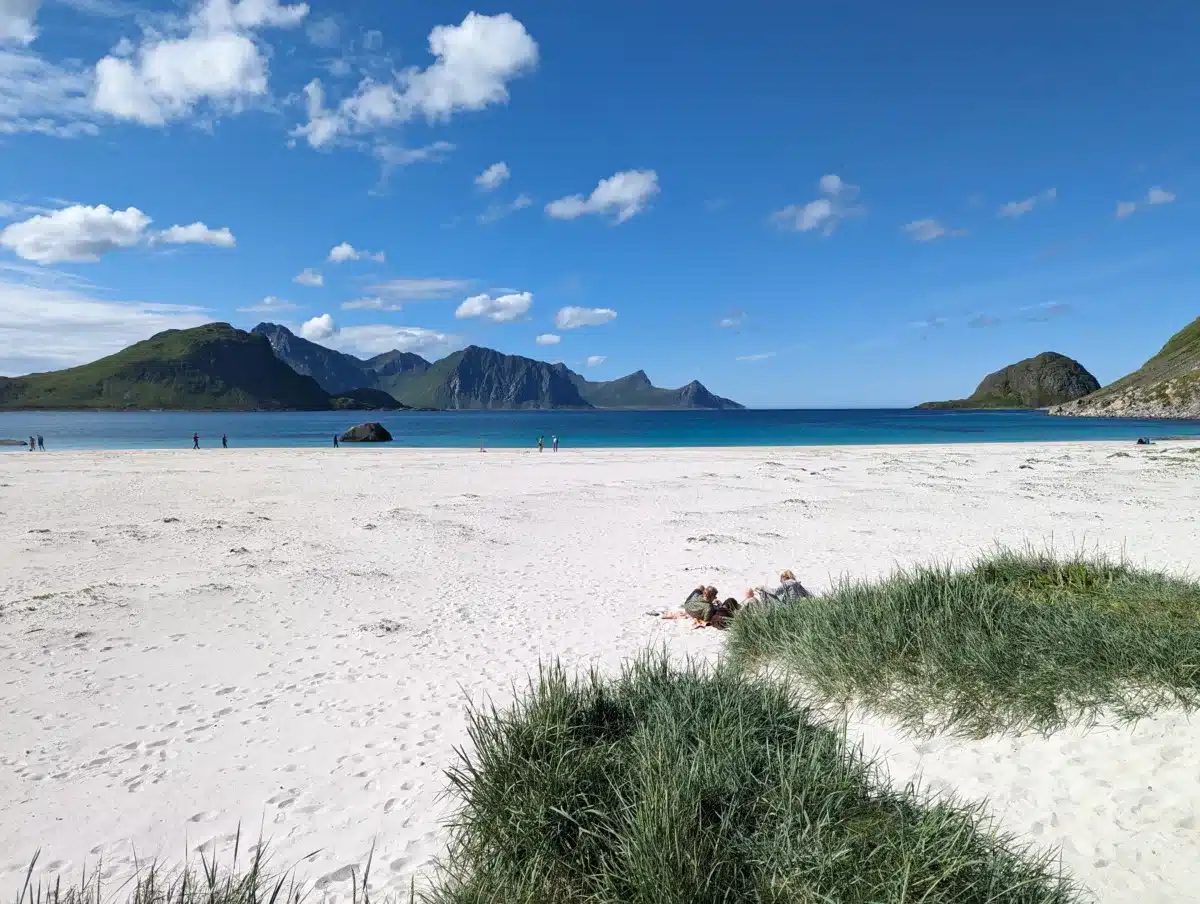
- Haukland Beach: welcome to Norwegian Polynesia! The beach is renowned for its white sand and crystal-clear water. It’s one of our favorite beaches in the archipelago, with a real end-of-the-world feel!
Henningsvær: the Lofoten Islands’ most famous soccer ground
The road from the south to the village ofHenningsvær is magnificent, and we drove past numerous white sandy beaches and coves with crystal-clear waters.
- We visited the village, famous for its archipelago of islets, located at the foot of a cliff, and the famous soccer stadium, honestly without a drone, the view isn’t incredible. We ate at HenningsværLysstøperi and Cafe, a super-cozy café with great home-cooked food.


- Festvågtind hike: this is a well-known hike on the Lofoten Islands, because at the top you’ll have a panoramic view of the fishing village and all the islets. For our part, the weather became completely overcast in the late afternoon, and as this is a difficult hike, it would have been a shame to go up and see nothing. Another good reason to come back!
2.5 km round trip – 500m D+ (climb)


- In the heart of Henningsvær: Villa Bryggekanten
- Good value for money: Fast Hotel Henningsvær offers stylishly decorated rooms with sea views from €70 per night.
Svolvaer: boat safari
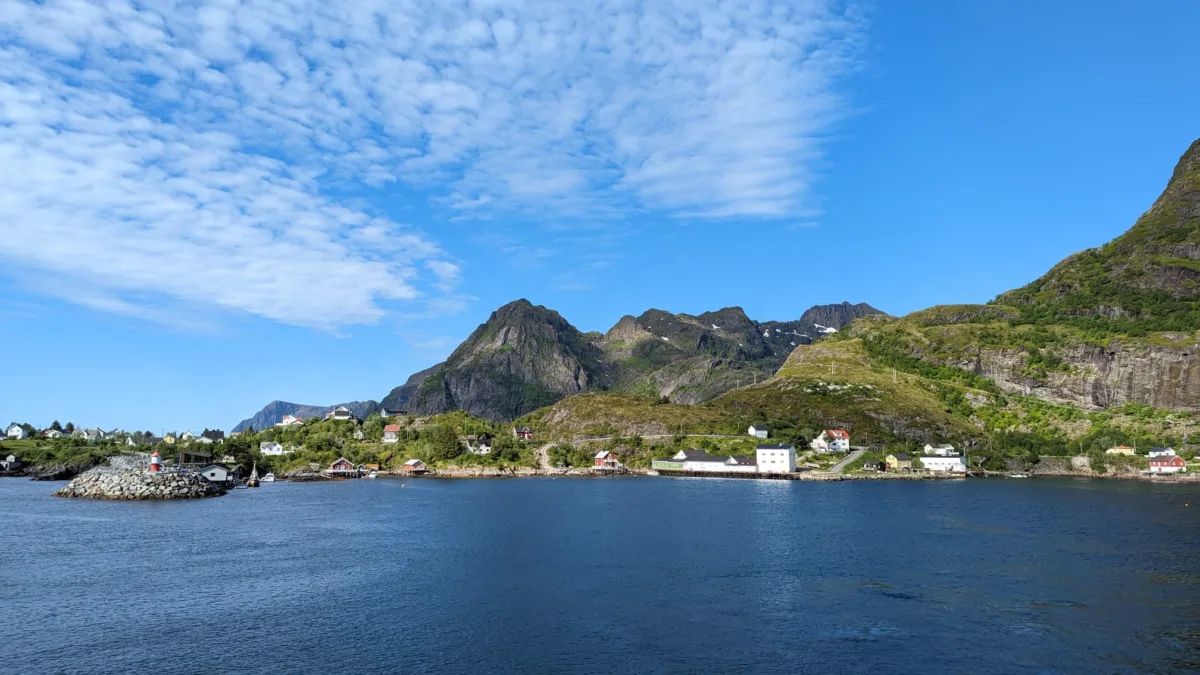
Last day in the Lofoten Islands, we set off by boat to explore the surrounding fjords, visiting nearby villages inaccessible by road, and spotted a sea eagle catching fish in the fjord waters. Quite a show!
We set off on a (silent) catamaran from the village of Svolvær (in the center of the Lofoten Islands), for 3h30, with the Brim Explorer company.
We then headed north to the island of Senja.
You can take the ferry (still free) from Svolvaer to Skutvik, then return your rental car to Bodo, and you’ve come full circle!


Practical advice for your visit to the Lofoten Islands (clothing, mosquitoes…)
- Clothing: prepare for a changing climate by packing extra layers and waterproof clothing and footwear.
- Budget: We’ve written a detailed budget for our stay, along with our tips for saving money while making the most of this little corner of paradise, which you can read here.
- The world: one last point we wanted to address to help you plan your trip and give you the most honest view of Lofoten, is that the archipelago is narrow and the number of visitors very large.
- Rental: rent your car and hotels as early as possible to have choice and simply space, as the tourist season is very short on the archipelago.
🚗 Find our complete guide with all our tips for renting your car in the Lofoten Islands.
🏨 And our guide to your hotels for easy access during your stay.


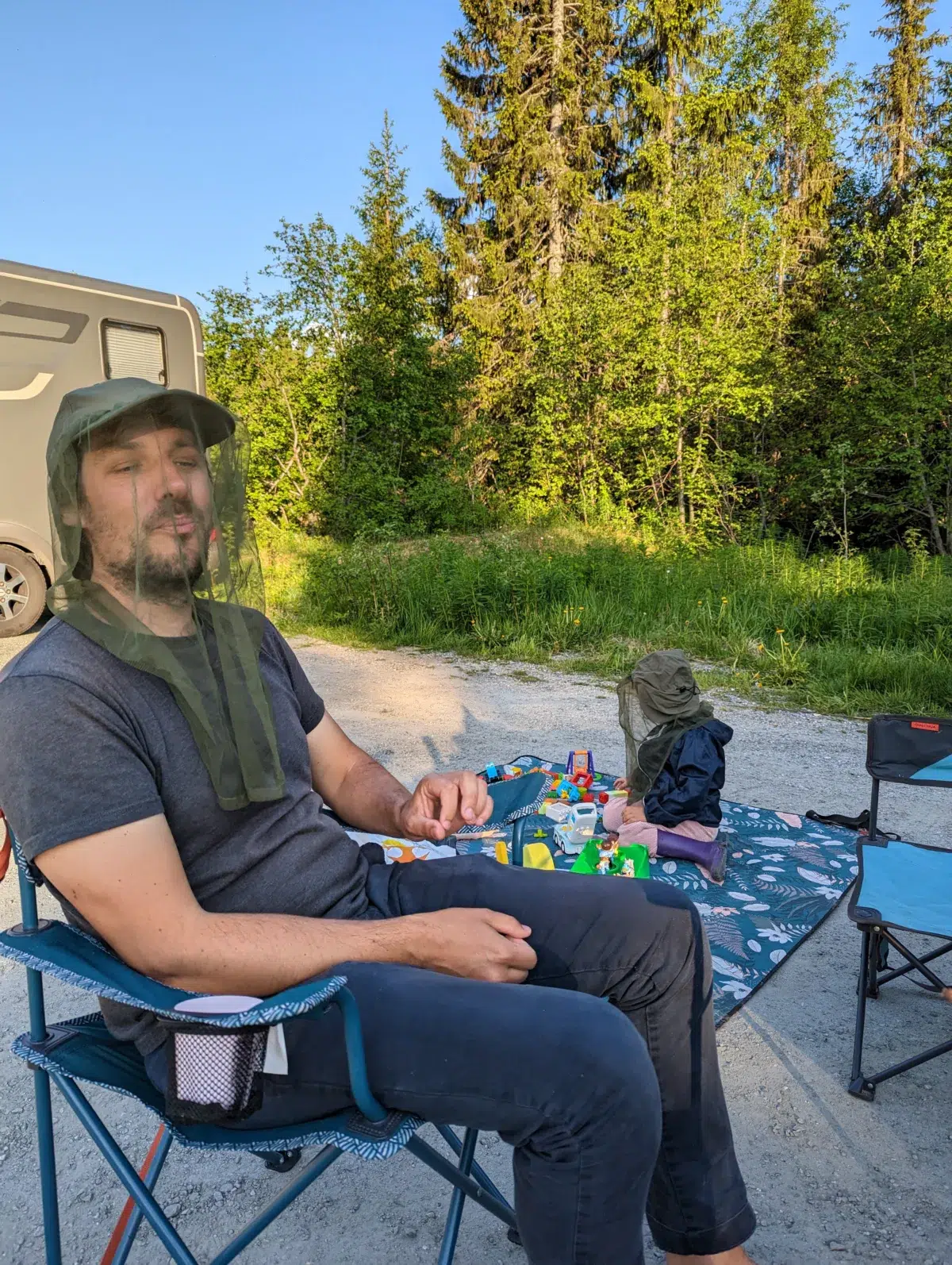
- Mosquitoes and vampire gnats: on the Lofoten Islands in summer, the bad news is that both are present… So we didn’t get much use out of the house in the evenings. We advise you to buy repellent when you arrive in Norway, and don’t forget it when you go hiking.
As for midges, there aren’t many, but if you’re in the same place as them, they’ll give you hell, and mosquito hats are just as ugly as they are ineffective! - The climate can be capricious in Lofoten, and the activities can sometimes be sporty: it’s better to have good insurance to leave with peace of mind, like the one we recommend in our article dedicated to Chapka insurance with a promotional code for the Cap Assistance 24h/24 contract.
Leave us 5 stars if you think Mathieu and our daughter are too classy!
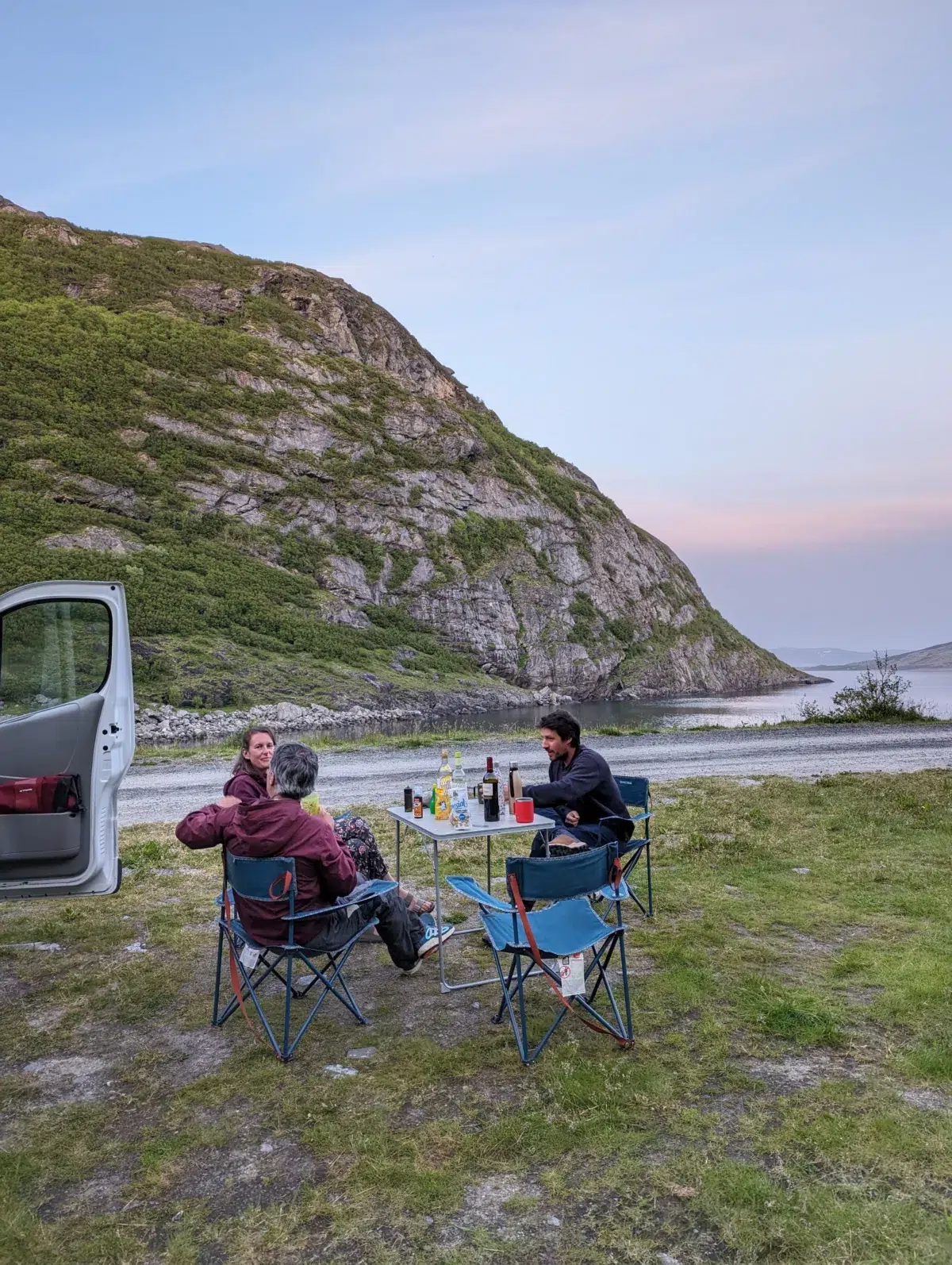
Our opinion on the Lofoten Islands
As you can see from this article and our photos, we loved our road trip to the Lofoten archipelago. The landscapes are varied and each more beautiful than the last. We were amazed to see beautiful white sandy beaches in northern Europe.
On the other hand, compared with southern Norway, we did feel a little oppressed at times. The parking lots are often full and the number of hikers on the trails numerous. Entrance to the village of Nusfjord is not free… We plan to return in winter to enjoy the peace and quiet.
We recommend including Vaeroy Island in your itinerary, so you can enjoy this little paradise almost to yourself!
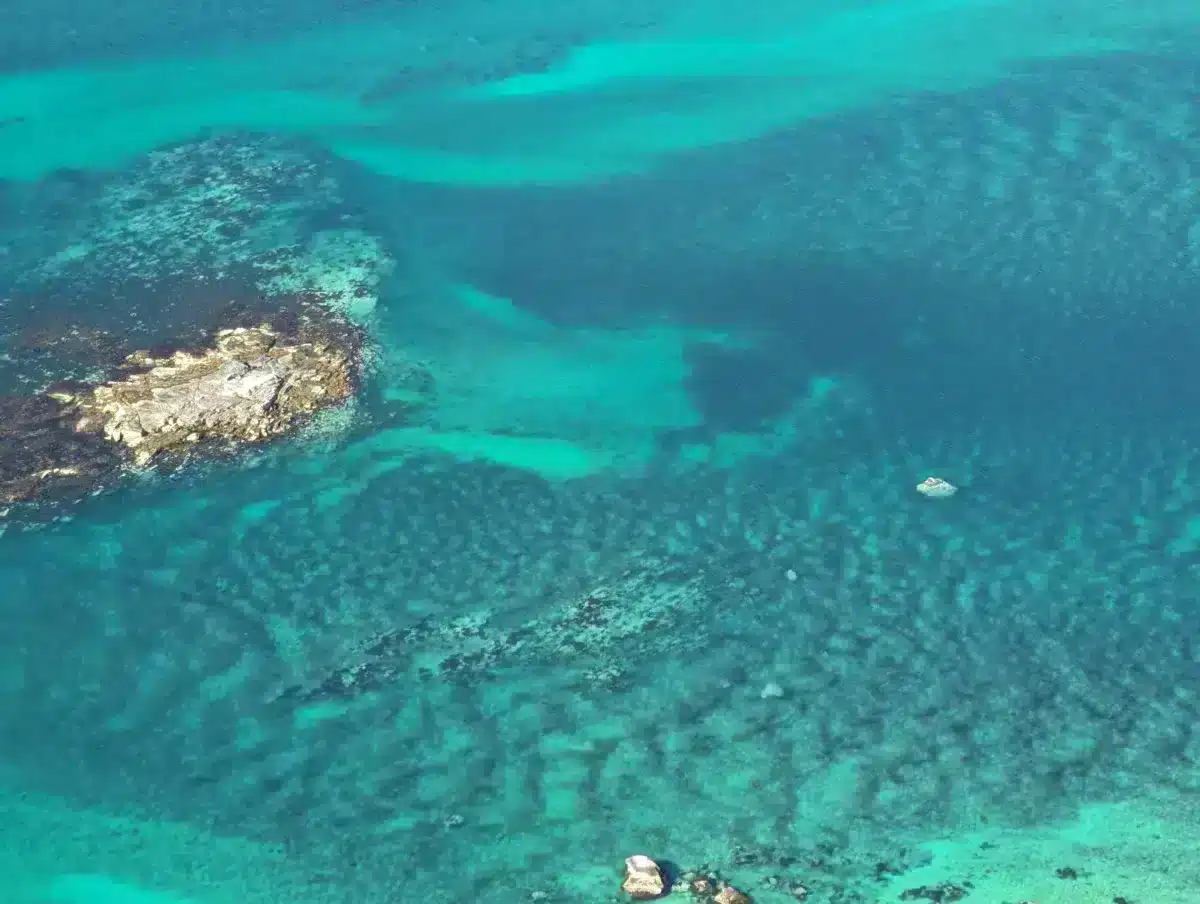
We really enjoyed writing this article. If you have any other suggestions, please feel free to leave a comment below. We spent 2 months in Norway, so check out our other articles about this incredible country.
Don’t hesitate to leave us a note or 5 stars below, to let us know if you’re planning this trip, to ask any questions you may have, below we’ll answer you with great pleasure. You can check out our Instagram stories from our Norway trip, to give you a taste of what’s in store!
Before you leave, find all our articles to help you organize your trip:
- Our budget in Lofoten
- 🏨nos meilleures hôtels aux îles Lofoten pour rayonner.
- Our guide to car hire in the Lofoten Islands
- Vaerøy Island : our favorite of Norway’s Lofoten Islands
- Lofoten Islands: must-see beaches
- Offersøykammen: a beautiful hike in the Lofoten Islands off the tourist trail
- The most beautiful places on the Lofoten Islands: in photos and on our map
- Visit the must-see village of Reine + its mythical hike

0 commentaires