




During our motorhome tour of Southern Europe, we spent three months in Greece. The archaeological site of Olympia was one of the most iconic places on that trip.
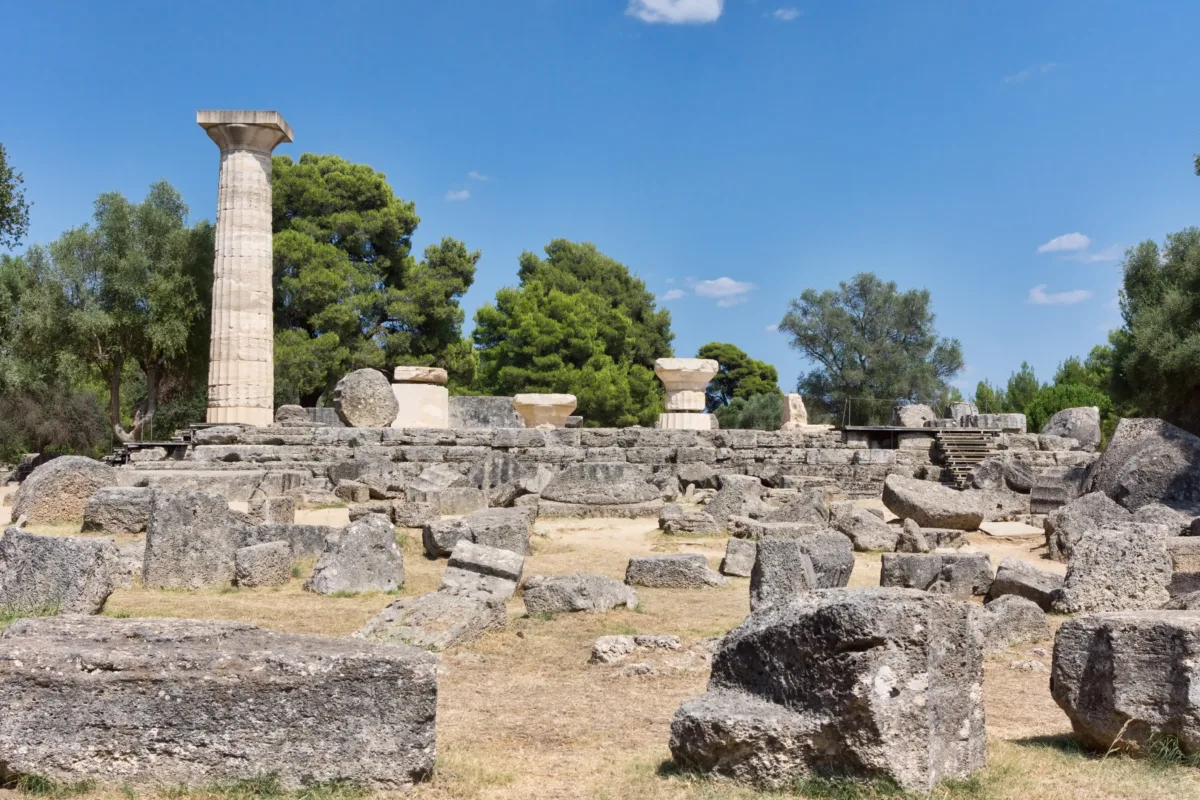
With its ancient ruins, historic stadium, and fascinating museums, Olympia offers a true journey into the heart of Greek history. In this guide, we’ll explain what to see, how much time to set aside, which ticket to choose, and how to plan your visit.
Practical Information for Visiting Olympia
Admission prices, hours, and useful information to help you plan your visit to the site and the museums.
Address and access
Ancient Olympia, 270 65, Greece. There is a parking lot near the archaeological museum, and parking spaces are also available in the village.
If you’re arriving by car, you can compare rental cars on DiscoverCars.
Tickets and Prices
Full price: 20 €.
Reduced price: 10 € for eligible visitors.
Free admission: specifically for European Union nationals under the age of 25, upon presentation of valid proof of eligibility.
The ticket grants access to four areas:
- the archaeological site of Olympia;
- the Archaeological Museum of Olympia;
- the Museum of the History of the Ancient Olympic Games;
- The Museum of the History of the Excavations at Olympia.
Hours and Free Days
- From April through the end of October: daily from 8 a.m. to 8 p.m.
- From November through the end of March: daily from 8:30 a.m. to 3:30 p.m.
- The last admission is 15 minutes before closing time.
Free admission for everyone: March 6, April 18, May 18, the last weekend in September, October 28, and the first and third Sundays of each month from November 1 through March 31.
Annual closures: January 1, March 25, May 1, Easter Sunday, December 25 and 26. On Good Friday, the site is open from 12:00 p.m. to 5:00 p.m.; on Holy Saturday, from 8:30 a.m. to 3:30 p.m.
Conditions are subject to change. Please check the official Olympie website before your visit.
Duration and Order of the Tour
Plan on spending at least 3 to 4 hours. A half-day is more comfortable if you want to explore the site and the four areas included in the ticket at your own pace.
We recommend starting with the archaeological museum to get a sense of the monuments through models and reconstructions, then exploring the site. Finish with the two museums dedicated to the Games and the excavations.
Accessibility
The museum has an access ramp. On the premises, paved paths and ramps make it easier for wheelchair users to get around. A wheelchair can be borrowed by calling in advance, and an accessible parking space must be requested in advance.
Pets are not allowed in the museum or on the grounds. Guide dogs and service dogs are permitted.
Our On-Site Tips
- Arrive early in the morning or late in the afternoon to avoid the heat and enjoy a more peaceful atmosphere.
- Be sure to wear sturdy shoes, as the terrain is uneven and the tour covers several outdoor areas.
- Bring water and a hat: there isn’t much shade, especially around the stadium.
- During peak times, please book your tickets online before you arrive.
- To enjoy some Greek specialties near the site, we really liked the Symposio tavern.
Visiting Ancient Olympia: What to Expect?
Olympia, the mythical birthplace of the Olympic Games
Olympia is not just a collection of ruins. The sanctuary was dedicated to Zeus and, every four years, hosted the athletic and religious competitions that gave rise to the Olympic Games.
Tradition traces the first recorded ancient Olympic Games back to 776 B.C.
The heart of the sanctuary, known as the Altis, was a sacred space surrounded by olive trees. It contained temples, civic buildings, and sports facilities.
Today, a complete tour consists of four complementary areas: the archaeological site, the archaeological museum, the museum of the history of the ancient Olympic Games, and the museum of the history of the excavations.
The site has been listed as a UNESCO World Heritage Site since 1989.
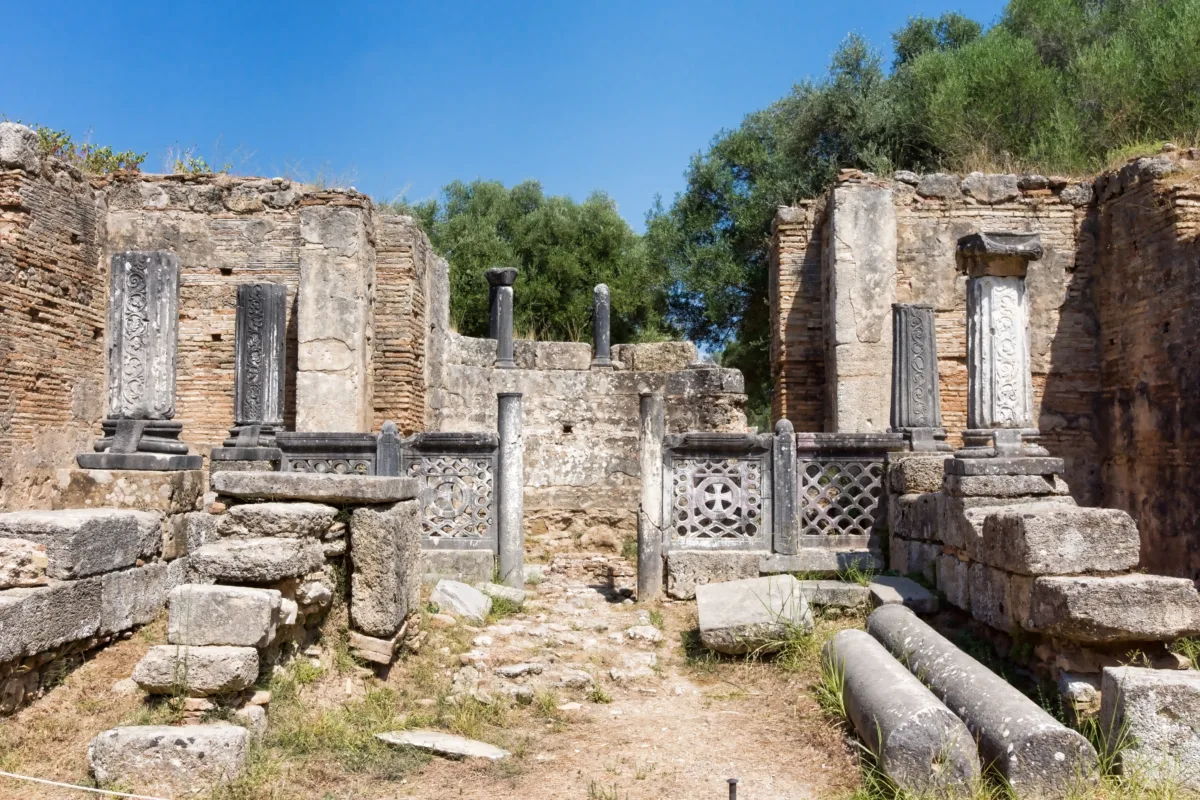
The archaeological site of Olympia
This is the most symbolically impressive part, but also the least clear from an educational standpoint.
Once there, we found very few informational signs. At the start of the tour, we felt a bit as if we were walking through a vast field of stones, and it was hard to imagine what it had originally looked like.
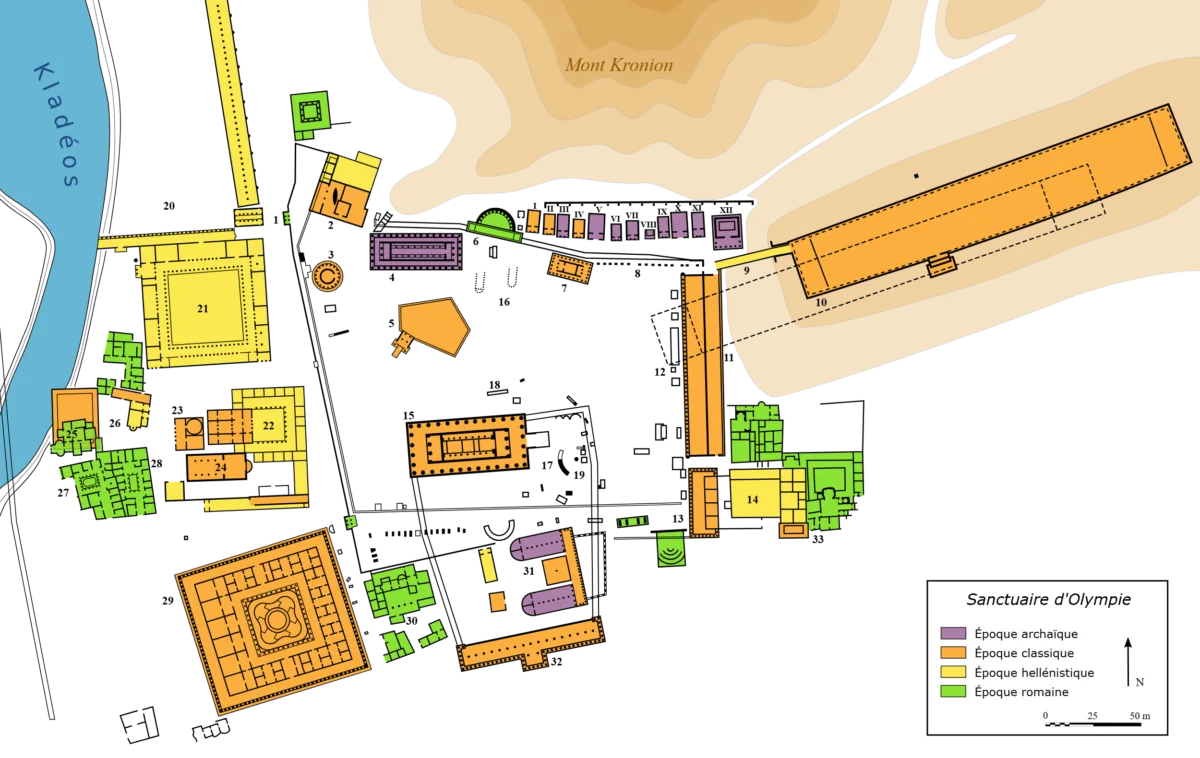
As you walk deeper into the sanctuary, you can gradually make out the monuments that defined the layout of Olympia:
- the Temple of Zeus, once one of the largest temples in Greece, whose collapsed columns give a sense of its scale;
- the Temple of Hera, one of the oldest buildings in the sanctuary. The modern Olympic flame-lighting ceremony takes place nearby, in front of the altar of Hera;
- the Philippeion, a circular building erected at the behest of Philip II of Macedon in honor of his dynasty;
- the foundations of the gymnasium and the palestra, where athletes trained;
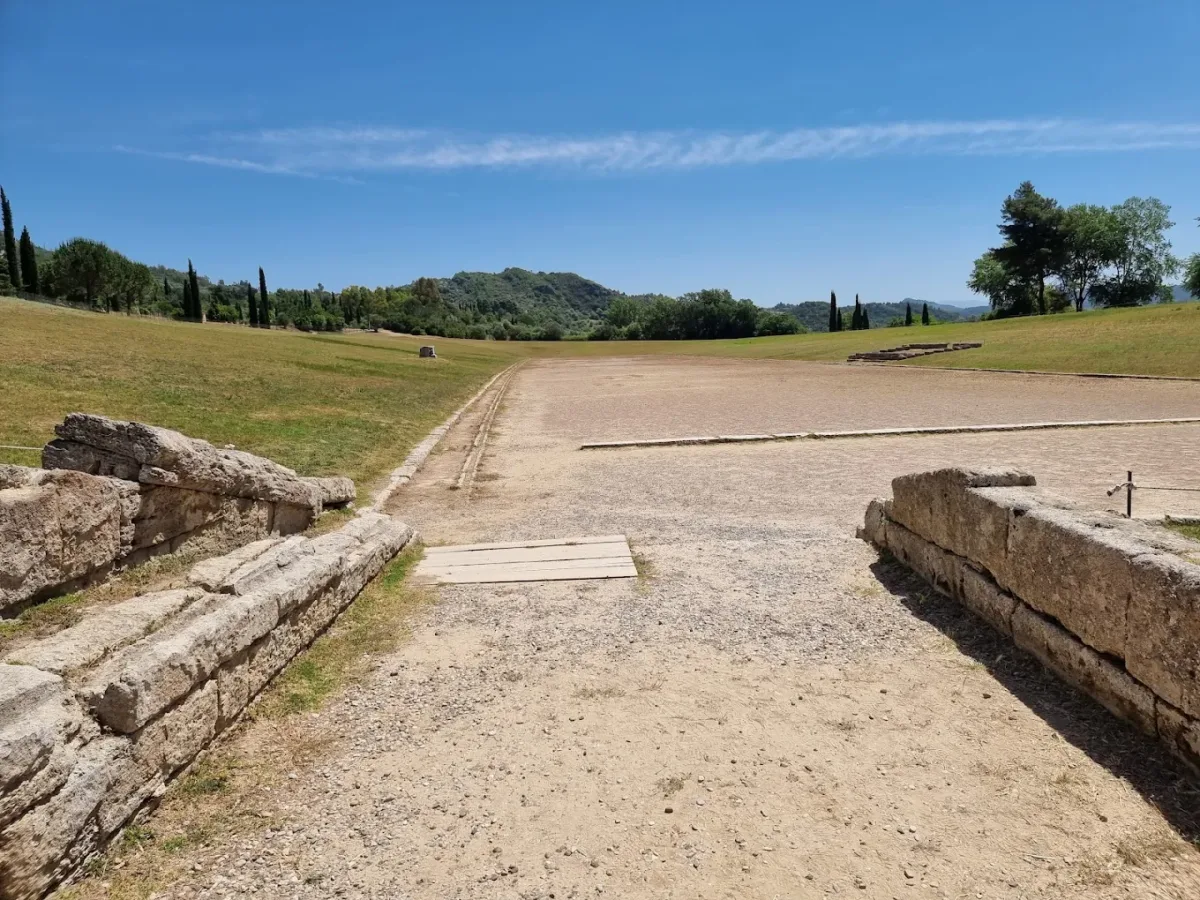
- the arched passageway that led to the ancient stadium;
- the stadium track, which is within walking distance. Our daughter loved running around it, just like the athletes of yesteryear.
Visiting Olympia with 3D glasses: Is it worth it?
Note: Many monuments are now nothing more than foundations. Without a guide, audio guide, or reconstruction, it can be difficult to understand what you’re seeing.
The cost may seem high at first glance, but virtual reality helps us visualize the buildings as they once were, understand the layout of the sanctuary, and place the events in their proper context. At a site where so little has been reconstructed, we find that the experience offers real value.
Our tip for cutting costs
- One headset for two visitors may be enough if you’re willing to take turns.
- If you’re visiting as a family, it’s best to bring one headset per child so that everyone can enjoy the experience at their own pace.
Map of the archaeological site
Olympia Archaeological Museum
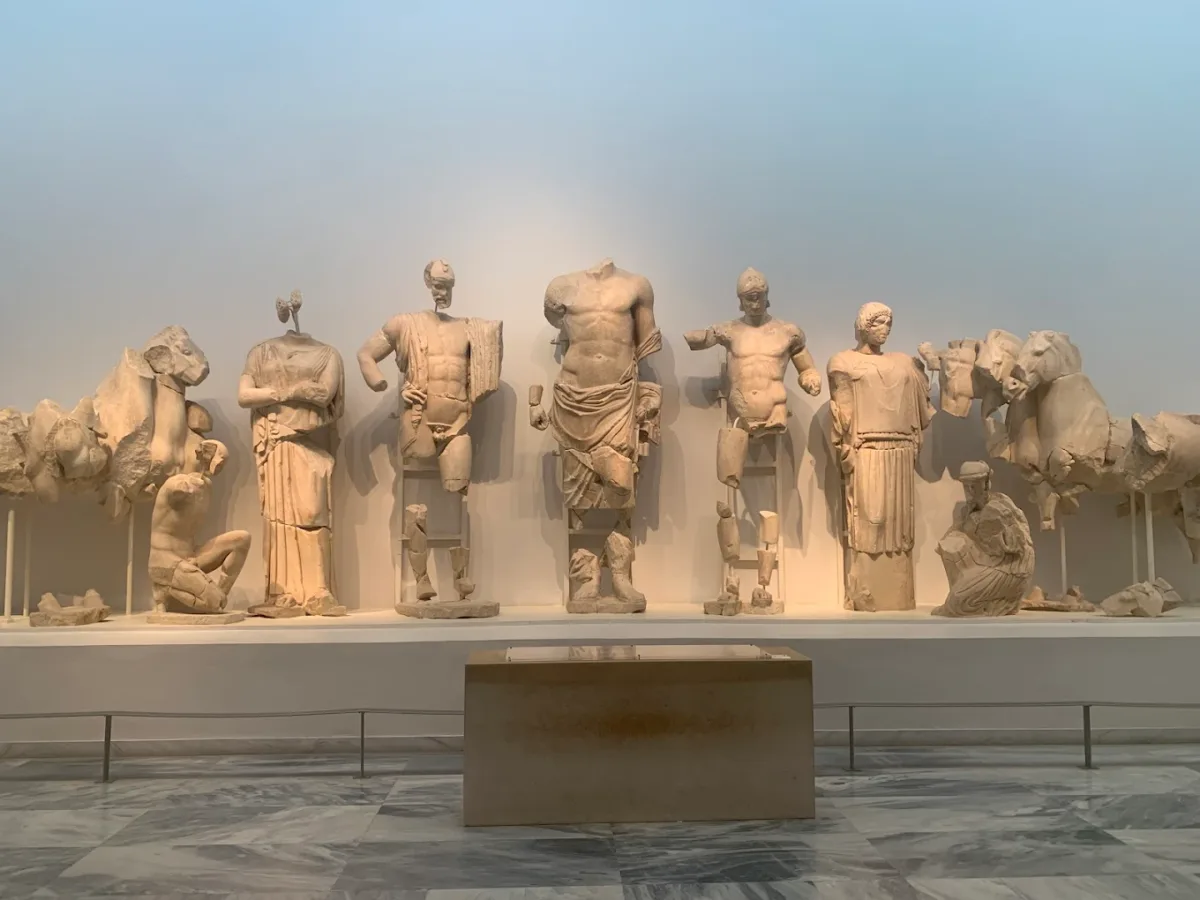
The Archaeological Museum of Olympia is one of Greece’s major museums. Its foyer and twelve galleries showcase the artifacts discovered at the sanctuary, dating from prehistoric times to the early Christian era.
It is located at the entrance to the site. We recommend starting with the museum: the maps, models, drawings, and reconstructions really help you understand the monuments before exploring the ruins.
Some of the must-have pieces include:
- Hermes Carrying the Young Dionysus, traditionally attributed to Praxiteles and discovered in the Temple of Hera;
- the Nike of Paionios, a masterpiece of classical sculpture;
- the pediments and metopes of the Temple of Zeus, displayed in the large central hall;
- the collections of bronzes, terracottas, weapons, ceramics, and votive objects from the sanctuary.
Allow about 45 minutes to 1 hour and 30 minutes, depending on how interested you are in the collections.
The Museum of the History of the Ancient Olympic Games
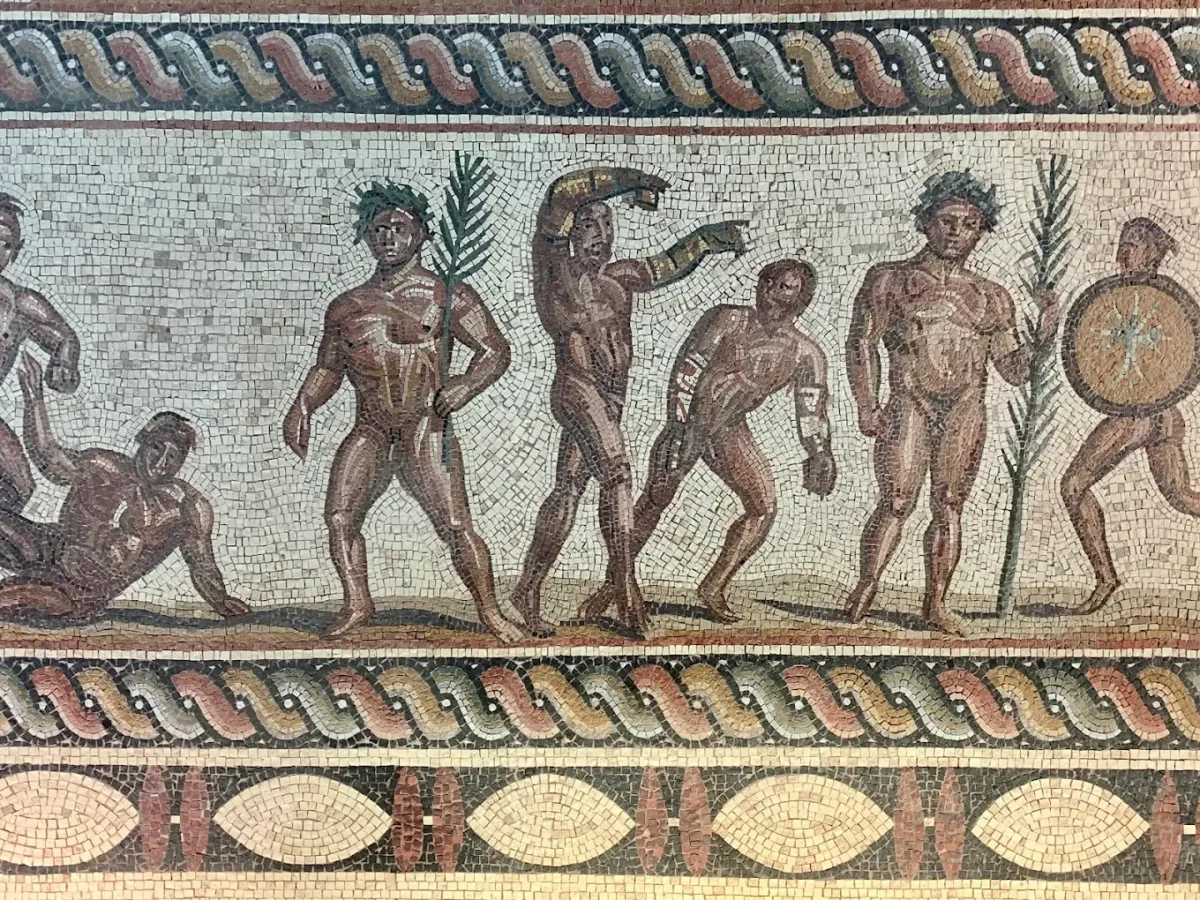
Although smaller, this museum is very informative and is dedicated to the history of the Games. It explores not only their athletic aspects but also their religious and social dimensions. It is easily accessible on foot from the archaeological site.
In particular, you’ll find:
- statues, painted vases, inscriptions, and artifacts depicting the origins of the Games, the rituals, and the athletes’ preparations;
- demonstrations of ancient sports: running, wrestling, javelin, discus, jumping, the pentathlon, chariot racing, and horse racing.
This is especially interesting if, like us, you enjoy learning about historical sports. Allow about 30 to 45 minutes.
The Museum of the History of the Excavations at Olympia
This small museum, located right next to the Museum of Ancient Games, chronicles the systematic excavations that began in 1875. It features engravings of the plain before the excavations began, photographs from the early excavation campaigns, the historic 1875 agreement, documents, and archaeologists’ tools.
The tour is brief, but it gives you a sense of the work required to restore the sanctuary that visitors tour today. Admission is included with the Olympia ticket.
Is Olympie worth a visit?
Yes, without a doubt. Olympia is a place worth visiting at least once to understand the religious, athletic, and political significance of the Games in ancient Greece. The stadium, the temples, and the artifacts preserved in the museums make for a very enriching visit.
The main drawback remains the lack of reconstructions and informational panels at the archaeological site. A guided tour, an audio guide, or 3D glasses make it much easier to interpret the ruins.
We also recommend visiting the sanctuary at Delphi, further north, with its stadium associated with the Pythian Games. To compare the country’s major sites, check out our selection of must-see archaeological sites in Greece.
Where to stay in Olympia?
If you’re looking for a place to stay near the site, here’s the address we highly recommend.
How to get to Olympia
Located in the northwestern Peloponnese, Olympia is accessible by car and bus. It’s an ideal stop on a road trip through Greece.
By car
This is the simplest and most flexible option. From Patras, the drive takes about 1 hour and 45 minutes. From Kalamata, allow about 1 hour and 50 minutes. These times are approximate and depend on traffic conditions. The roads in the Peloponnese are generally in good condition, and parking is easy around the village and the museum.
Check out our guide to renting a car in Athens and planning your road trip in Greece.
By bus
Regional buses run between Olympia, Pyrgos, and Krestena. If you’re coming from Patras, Kalamata, or Athens, you’ll usually need to transfer, most often in Pyrgos. Schedules vary by season, so it’s best to check them before you leave.
Visiting Olympia from Athens
- By car: Allow about 3 hours and 30 minutes to cover the approximately 290 km between Athens and Olympia, assuming no long stops and depending on traffic conditions. You can compare car rental deals at Athens Airport on DiscoverCars.
- By bus: The route usually goes through Pyrgos and takes about 5 to 6 hours, depending on the connection.
- With an organized tour: This option saves you from having to drive and includes round-trip transportation for the day. Be sure to check the details of the option you choose, as admission fees and guided tours at the site may vary.
Where is Olympia located?
Ancient Olympia is located in the Elis region, in the northwest of the Peloponnese. The archaeological site and museums are situated right next to the modern village, making it easy to walk to the various attractions.
The area is lush and green, surrounded by hills and olive groves. The landscape really adds to the experience, just like at Meteora, another major Greek site set in a spectacular setting.
While Olympia is one of the heartlands of Greek civilization, some of the treasures of antiquity are also found in southern Italy, such as the site of Paestum, south of Naples.
Olympie on Video
We recommend that you watch this short video before your visit so that you’ll have a better understanding of the site once you’re there.
Feel free to leave us a quick note below to let us know if you’re planning this trip, ask any questions you may have, or share the article on social media. You can also find us on Instagram—we’d be happy to reply!



0 commentaires